

You have found a convenient stop marked “on request” in an international bus timetable. It is closer than the large bus station, so you are tempted simply to turn up and wave to the driver. But for a particular intercity service, that label may mean you must book the journey from that exact point in advance. Without checking, you risk waiting for a bus that is not required to call for your unconfirmed plan.
This concerns a conditional passenger point provided in the operator’s timetable. It is not any place where a vehicle sometimes stops, nor permission to join a service near the border. Your task is to establish the required stop’s service condition before leaving home, obtain proper confirmation and fulfil it without dangerous actions on the road.
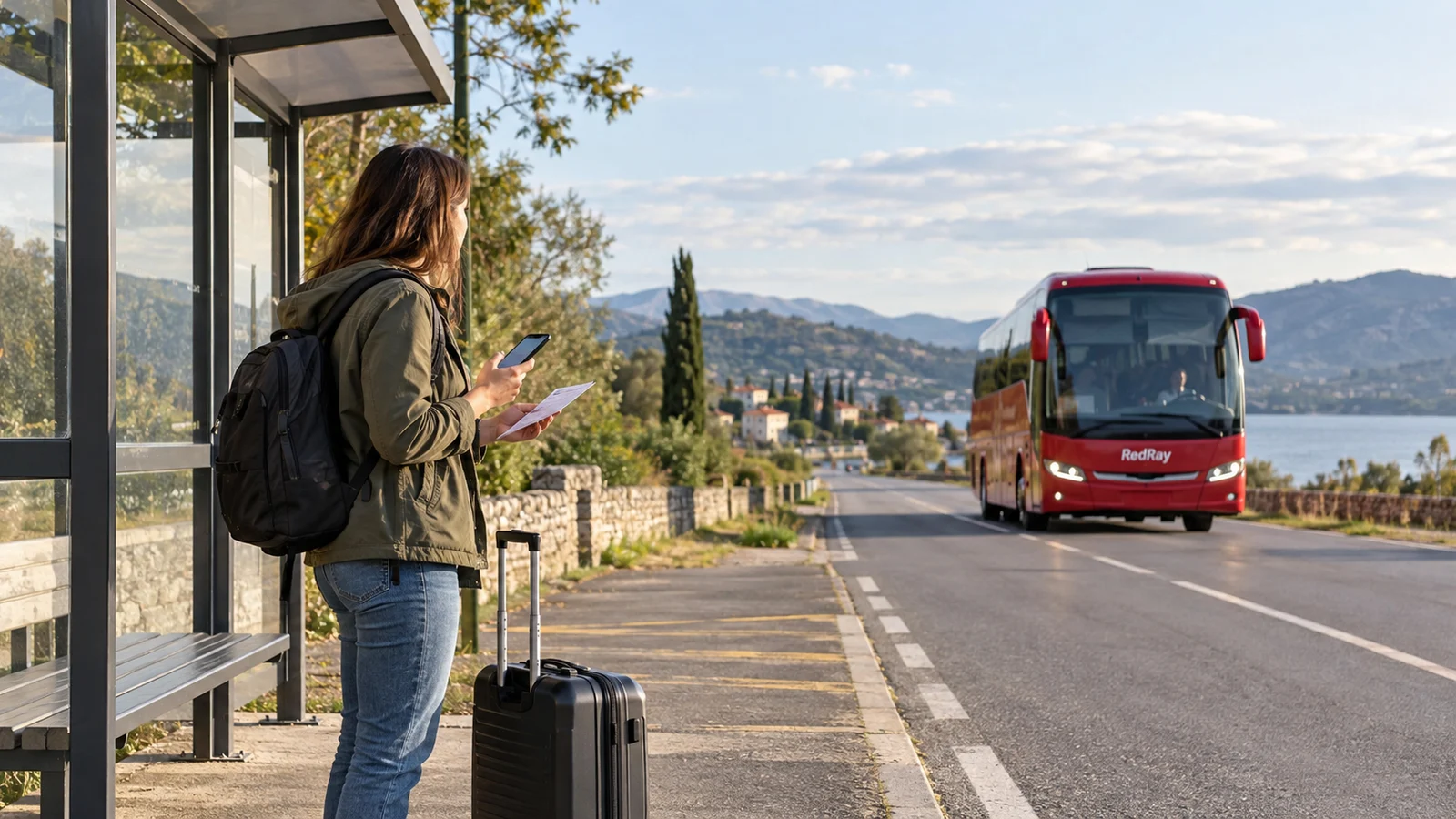
First establish the stop type
A route diagram may include ordinary boarding points, drop-off points, technical pauses and request stops. All look like dots along a route, but the ability to book the required section differs. An icon on an outside map, a photo of a bus at a petrol station or a friend’s memory does not explain the point’s status for your date and direction.
Find the symbol’s explanation in the official timetable. If it uses another language, translate not only the stop name but also its note. Do not automatically interpret conditional calling through your experience of city buses. How to notify the operator, whether booking is necessary and when to appear need separate clarification.
For example, the request-stops provision in FlixBus’s official conditions links service to booking within the deadline specified for the relevant timetable. This particular example shows why waiting by the roadside alone may be insufficient. It does not establish identical arrangements for all international carriers or every stop in that network.
Questions to ask before booking
State the country, settlement, exact stop name and direction, date and service. Ask whether booking from this precise point is available, whether there is an advance-request deadline and where it is published. Separately establish which confirmation means your request is accepted. “Request received” does not always mean booked travel.
Also establish whether a purchased ticket is sufficient or the particular point has an additional notification procedure. Do not invent an extra call if it is not required, but do not omit an expressly stated action either. The answer must concern your departure, not a general “Our buses pass there.”
- Is this point a passenger stop for my direction and date?
- By when must the journey be booked, and how can I check that condition is fulfilled?
- Which name and address will appear on the valid ticket?
- Where is it safe to wait, and how do I identify my service?
- Which official contact should I use if the bus is not visible?
If you need boarding assistance, report it before an irreversible decision. A stop being available for sale does not itself describe kerb height, lighting, surface or wheelchair access. Ask about access to the required side of the road. Complex luggage likewise requires separate agreement of carriage conditions, not merely confirmation that the bus will call.
Check the result, not just payment
The document must show your required section, not a similar neighbouring town. Check direction, date, passenger and journey starting point. If support agreed a change, check which document confirms it. Save the current version and operator’s explanation so you can open them at the stop without a stable connection.
Do not buy a ticket from a large city secretly intending to board later at a request stop. Some operators’ official rules restrict joining from a point other than the booked one; check alternative boarding before changing plans. The fact that the chosen bus will pass nearby does not make your document valid for an arbitrary location.
If someone else makes the booking, ask them to send the complete current document and required instruction, not only a screenshot of the service name. Check who will receive operational messages. A passenger must know their point and contact independently: the organiser may be unavailable just when a brief explanation to the operator is needed.
Wait without making boarding risky
Before leaving, check the latest point and time notification. On site, stand in a permitted waiting area where you do not need to be on the carriageway. Do not step into a lane, bypass a barrier or obstruct traffic to be noticed. If navigation directs you to the opposite side, first find a permitted pedestrian route or clarify the point through the official contact.
As a bus approaches, do not identify it solely by colour or logo. Before handing over a suitcase, check the service and destination with the crew. Follow the boarding procedure received. If the operator describes how to signal your presence, do so only from a safe place; it cannot justify running in front of transport.
If the required vehicle does not stop, do not run after it or ask friends to pursue it. Stay in a safe area and report the facts to support: booked point, service, date, your arrival time and what you saw. Do not immediately claim the bus deliberately passed you: you may have mistaken the vehicle, direction or current calling location.
The deadline has passed or confirmation is missing
Do not spend your remaining energy travelling to a request stop hoping to negotiate on site. First establish whether travel is booked and the required advance action completed. If not, ask about an available point or another departure. Agree an alternative before travelling independently to another town, especially with large luggage or at night.
If the operator offers another point, check not just its name but the actual time and safe route to boarding. Clarify the old document’s status and whether another payment is needed. Do not assume correspondence automatically reissued the ticket. Before agreeing, ask what exactly has changed and which parts of your journey remain valid.
For an enquiry, retain the timetable note, the date checked, valid document and support responses. Do not publish a QR code in a local group asking “Someone stop my bus.” Chat participants cannot confirm carriage, and an exposed document creates unnecessary data risk. The party responsible for the particular booking and service makes the required decision.
Check the return direction afresh
A request stop outbound does not guarantee identical return arrangements. The side of the road, booking point, provider and timetable note may differ. A saved photo of the first boarding does not replace checking the return document. If you change day or direction, repeat the question about the request deadline rather than applying the previous answer without clarification.
A short private note is useful: “My point—service condition—where confirmed—official contact.” It is more useful than dozens of forwarded messages among which the current one is hard to find. Do not include unnecessary passport details. Identifying your journey requires only the necessary ticket data, accessible solely to you and the responsible party.
Questions and answers
Does “on request” mean I should wave?
Not necessarily. For an international service, it may be an advance-booking condition rather than a roadside gesture. Read the operator’s explanation for the specific point and follow the confirmed procedure while remaining in a permitted safe area.
I can see the stop on a map but cannot book a ticket. What does that mean?
The map alone does not explain sales availability for your date. Ask the responsible party about the point and section’s status. Do not buy another point to bypass a restriction or assume the driver will fix the booking on site.
Is it enough that my friend is boarding at this stop?
No. Their confirmation does not book your journey. Check your own document, date, direction and fulfilment of the required condition. Even waiting together does not replace each passenger’s valid ticket.
Is the request deadline identical for all stops?
Do not establish it from someone else’s journey. If the operator sets one, find it for the relevant timetable and point or request an official explanation. A recommendation to arrive early and a booking deadline are different things.
What if a confirmed bus did not pick me up?
From a safe place, use the official contact, identify the service and point, and retain your arrival time and the explanation. Do not pursue transport or travel to the border independently. The next option and payment status need separate clarification.
Further reading and sources
Compare this with ordinary intermediate boarding and a technical stop before the border. Examples of operator rules: FlixBus and National Express. Sources checked on 23 October 2026.