

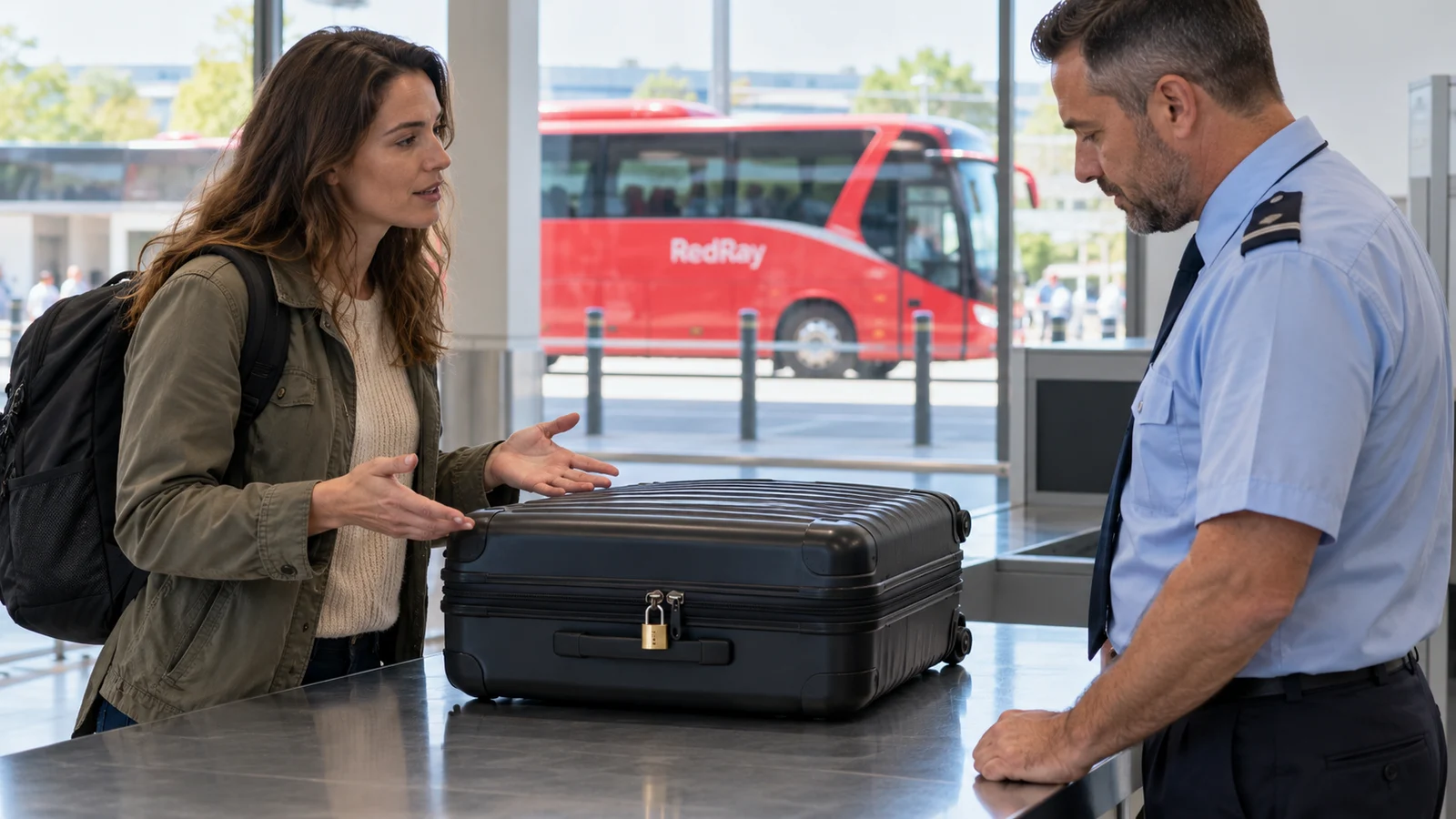
Your suitcase is on the inspection table. You recognise it and can explain its contents, but the lock will not open: the key is at home, you forgot the combination or the mechanism stopped working. Passengers from the same bus gather behind you and you want to do something immediately. Now it is more useful to explain the obstacle clearly to the inspecting officer than to search for a random tool.
A failed lock does not mean permission to skip inspection, but does not require an invented story either. Your task is to describe the problem truthfully, establish agreed access arrangements and keep in contact with the crew. This article does not teach lock opening or determine authorities’ powers in different countries: clarify the particular procedure on site with a competent officer.
Report the problem before another attempt
Start briefly: “This is my suitcase. I cannot open the lock because I do not have the key” or “The combination I used is not working now.” State only an established fact. If you do not know why the mechanism jammed, do not attribute it to transport damage you did not witness. Different causes may require different next steps, so label assumptions as assumptions immediately.
Ask whether to stop trying and how access should now be provided. Do not start moving sliders, removing parts or taking out tools during the conversation. The officer must understand what you intend to do. If asked to wait, clarify exactly where and whether the suitcase should remain nearby. Do not move to another table or carry it to the bus by your own decision.
Do not confidently state a combination if you are only trying guesses. Explain that you cannot remember the exact value. If phone information or a relative’s help is needed, ask to use communication in a permitted way. Do not photograph the workplace or official actions to show a relative “what kind of lock this is”: words or an existing home photo of the suitcase itself are often enough.
Separate customs questions from bus questions
The authorised officer explains further inspection procedure. The crew coordinates the bus and passengers. Do not ask the driver to decide instead of customs whether the procedure can end, or treat “The bus is getting ready” as permission to leave the check. First establish your actual status, then tell the crew exactly that without promising everything will be finished in a minute.
A crew message could be: “My luggage inspection is unfinished because of a lock problem. I am in the place specified by the officer. Please clarify how to keep in contact with you.” Location, situation status and available contact matter more than a long account of every attempt. If the phone is unavailable, ask for a permitted notification method; do not leave the procedure independently to find the driver.
Separately check where your remaining belongings are. Your carry-on bag, passport and ticket must not be lost while all attention is on the lock. If a companion waits near the bus, agree simple updates, but do not ask them to move your suitcase or answer about its contents for you without proper agreement. Communication help and participating in customs proceedings are not the same role.
Agreed access is not an independent experiment
Ask specifically what actions are expected from you now and who will explain the permitted access method. If a proposal is unclear, ask for it in simpler words. Understand whether it means waiting, an action you take under instructions or an action by appropriate staff. Do not agree to an unclear description just from fear of delaying others, but do not substitute your own internet procedure either.
Do not involve a random “repairer” promising to open everything discreetly, or hand them your suitcase, passport or money. Do not independently organise repairs or outside services in a controlled area. Even a familiar home-lock method may damage packaging, create danger or conflict with the particular inspection procedure. Everyday convenience does not replace a permitted sequence.
If an interpreter helps you understand, ask them to convey questions and answers accurately. Do not let them invent consent on your behalf or claim you knew of the fault beforehand when you did not. Before signing any document, establish its contents and purpose. There is no universal “broken-lock paper” for every country; understand the particular materials relevant to your case.
If the situation takes longer
Do not plan onward travel around another passenger saying “It is always quick here”. Ask the responsible officer what is happening and what action is expected next. No exact deadline is better than an invented promise to the crew. If you were told only to wait, report that: arrangements are being clarified and completion is unconfirmed. This allows discussion of real transport options rather than lost contact through repeated unfounded forecasts.
If you cannot continue on this bus, clarify two separate questions: whether you may leave the procedure location and what happens to your ticket and remaining luggage. Do not buy another service merely because an app still shows seats. First understand whether you can leave, where to collect belongings and the actual new boarding address. A lock problem does not itself establish a right to a free replacement ticket.
Record the factual sequence for yourself without filming prohibited subjects: when the obstacle appeared, whom you told, instructions received and the confirmed outcome. Mark approximate times as such. Exact circumstances help a later private enquiry more than guesses about fault. Do not share other people’s documents or faces in the service chat alongside your delay description.
After opening, check more than the lock
Once required actions are complete and you are allowed to gather belongings, check your own set under the agreed procedure. Return documents and small items to designated places first, then close the main packaging. If something is missing, report it before leaving rather than returning independently across the control line. Organising your set can be helped by a private photo inventory prepared in advance.
Assess whether the suitcase can remain closed during further carriage. If the mechanism or case changed, show the actual condition to the crew and agree acceptable packaging. Do not treat tape or a strap as a universal solution: belongings must not fall out and packaging must allow safe stowage. Do not hide the problem under a cover just to load faster.
If a separate question about the item’s condition arises, establish where to enquire and which existing confirmations concern the event. Do not automatically conclude the carrier, customs or insurer must cover expenses. A later review needs circumstances and applicable conditions. If the item was not returned at all, that is another situation: separately read how to establish its status and required documents.
What to change before the next service
Test the lock at home on both an empty and packed suitcase rather than relying on it having worked a year ago. The key must be accessible to the owner, not inside the locked suitcase. Store the combination so it is not lost with your only phone or disclosed publicly. Do not write it in large digits on an external tag beside contact details.
Before departure, review your particular international service’s contractual requirements. For example, FlixBus conditions contain a separate provision about checked luggage being accessible for customs clearance; this illustrates one network’s rules, not instructions for every bus. General information on inspection and interaction with an inspector in Ukraine is provided by the State Customs Service. Sources checked on 23 October 2026.
Questions and answers
Can I simply say the key is missing and not show the contents?
You must report the missing key, but that does not determine the inspection’s outcome. Ask the competent officer about further procedure and follow agreed instructions; a failed lock creates no automatic inspection exemption.
The key is inside another suitcase on the bus. What should I say?
Describe its exact location and establish a permitted retrieval method. Do not open the compartment independently or ask a passenger to move others’ luggage. Access to the second suitcase requires separate agreement.
Must the driver open the lock for me?
Do not assume that obligation or technical ability. The crew needs your status, but the relevant service determines inspection procedure. Discuss assistance openly without unauthorised repairs in the controlled area.
Can I send the lock combination to the service’s group chat?
Do not disclose it to everyone. If information is needed for a particular agreed action, clarify the appropriate recipient and private method. Reporting a delay to the crew does not usually require the combination itself.
If the lock had to be changed, will the expenses definitely be repaid?
No. Expenses alone do not determine responsibility. Retain received documents and a factual event description, and check the applicable enquiry procedure. This article establishes no entitlement to a particular payment.