

Your passport is returned, the bus doors close and the vehicle starts moving again. You tell relatives “That is it, we are through the border”, put the folder at the bottom of your bag and try to sleep. Yet at the next stop there is another request to prepare documents. The mistake was not in the papers but in the conclusion: you treated the end of one stage as completion of the entire border section of the route.
This article helps you understand your own next step, not determine your right to enter or the length of checks. Control locations and procedures depend on the particular crossing and officials’ instructions. Do not identify the stage solely from a building’s appearance, uniform colour or other passengers’ movements. A brief explanation of what has been completed in your particular case is more reliable.
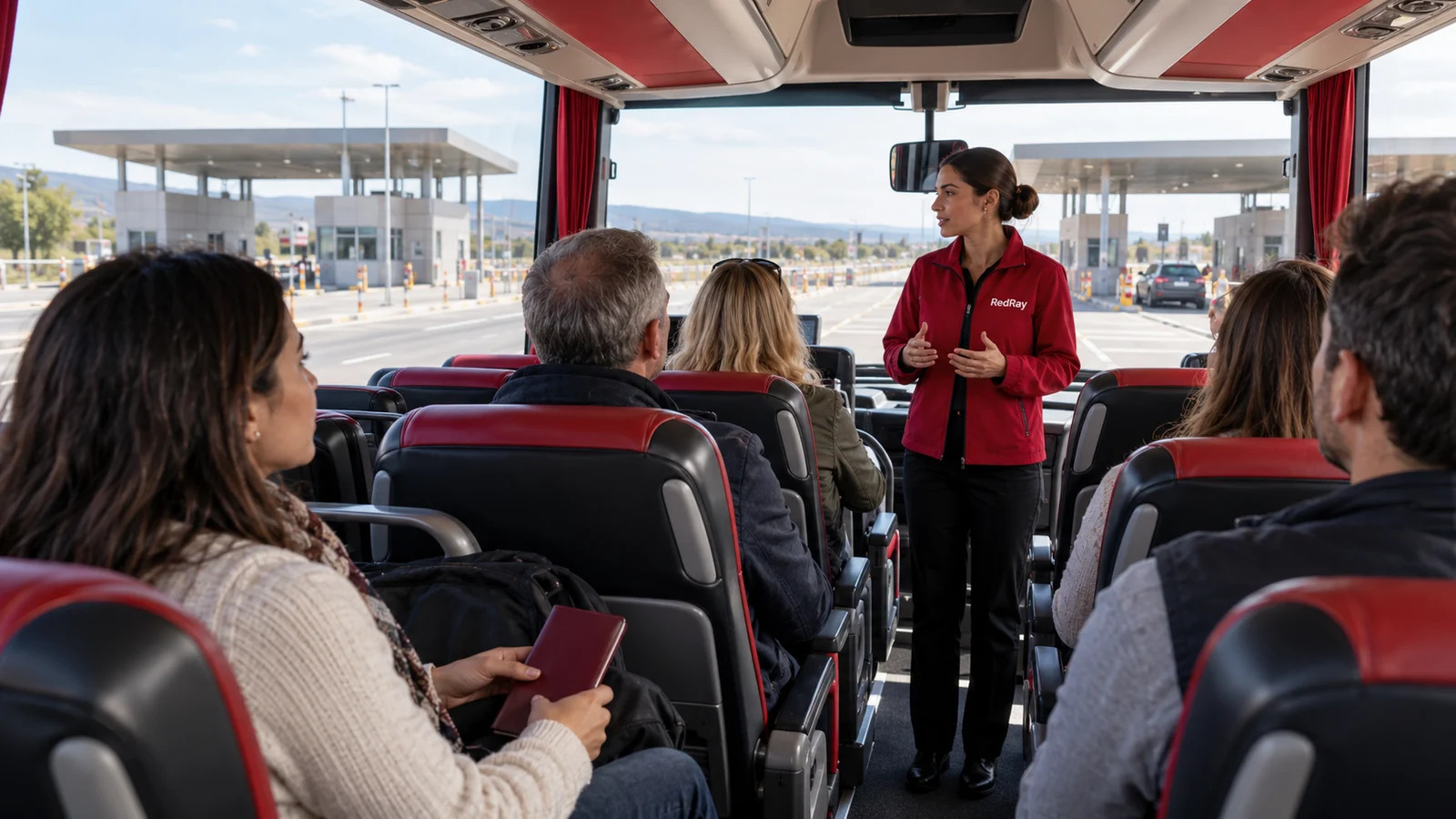
One completed action does not describe the whole crossing
An international journey may involve successive matters concerning exit, entry, belongings checks and vehicle movements. Do not turn this into an identical mandatory sequence for every bus. The practical task is simpler: distinguish a known fact from the next action that has not yet been explained. “My passport was returned” is a fact; “All checks are behind us” is a conclusion requiring confirmation.
Similarly, starting to move may mean relocating to another permitted place, not leaving to continue the route. Do not stand up to gather large belongings or move towards the door before understanding the crew’s instruction. If you woke up after an announcement, ask what it said. A neighbour’s “We are moving now” does not explain whether you need to prepare to get off again.
On the Ukrainian side, separate security rules regulate presence at a border crossing. In particular, the official procedure links movement around the site to established routes and designated stopping places. This is not an instruction for passengers to choose their own way. On the other side, follow explanations from its responsible service rather than treating the Ukrainian rule as a ready-made answer for every country.
Ask about the next action
At an appropriate moment, ask the officer giving you instructions: “Is this stage complete for me? Where should I wait now? Do I still need to keep my documents ready?” If the question concerns bus movements, ask a crew member. Do not demand that the driver determine your personal entry rights or that an official guarantee arrival time at the final city.
You do not have to memorise every department’s name if they are unfamiliar. You need to understand the action correctly: stay on the bus, wait in an authorised place, prepare a particular document or move according to a specific instruction. Briefly repeat what you heard if unsure. “Am I staying here until I am called again?” is better than a silent assumption that leads others to search for you.
If language is difficult, ask for an available explanation or permitted translation method. Do not choose a meaning for an unfamiliar word just because it allows a more convenient exit. For a practical question, identifying your bus and your need to understand the next step is enough. You do not need to post your passport, personal status or entire travel history in a group chat to interpret one announcement.
Do not put documents away too early
Once a document is returned, check it is yours and put it somewhere accessible and under your control. Do not hand the folder to another adult simply because they have finished their part of the check. Your next procedure may differ. If you need to get off again without a shared bag, your required personal set must not remain with someone else.
Accessibility does not mean constantly holding an open passport. It is more convenient to have one clearly designated place for the original, ticket and supporting documents already identified as necessary for your case. Do not create new certificates each time the bus moves. If asked for material not to hand, explain where it is and establish the proper access procedure.
If you have already put a document in a suitcase, do not open the luggage compartment yourself. Tell the responsible person you need a particular item and follow the agreed procedure. Do not ask a passenger to secretly fetch the folder for you. Practical inconvenience does not justify action contrary to current border-control instructions.
Report the stage, not the hoped-for result
Instead of a general “We are through the border”, write: “One check is complete and the documents have been returned. The next steps are still being clarified.” If you have expressly been told another stage lies ahead, say so without predicting its duration. Someone meeting you will then not treat the message as a signal to leave immediately for the stop or abandon other commitments.
You do not need to send updates after every short movement. Agree a useful point: the next confirmed change in the journey’s status or continuation of the route following the relevant instructions. Send messages only when permitted and safe. No message during a control stage does not by itself explain the reason and must not trigger unauthorised searches by relatives.
If you have already sent premature news, correct it directly: “My previous message was inaccurate: only the first check was finished.” Do not bury the correction in a long account of your impressions. Separately ask for only the plans relying on it to be reconsidered. A new message does not mean every subsequent booking automatically needs cancelling or buying again.
Members of a group may be at different stages
Within a family or group, do not draw a conclusion about everyone from one returned document. Each adult should understand their own instruction. An organiser can gather minimal information for the crew, but should not demand explanations of other people’s private circumstances. Coordination often requires knowing who is already in the permitted place and who is still following instructions received.
If some people are directed elsewhere, do not independently choose a new meeting place between control areas. A prior family plan does not override the actual arrangements on site. Ask an official where to wait after your stage and how you are permitted to inform your companion. A more detailed separation scenario is described in the article on different control halls.
Shared belongings should not move in response to every assumption either. If a companion has your charger and you have their folder, do not look for a way to pass them over a barrier. Explain the specific need to the responsible person. For the next trip, reduce these dependencies before checks: let each person access their necessary set without giving everyone copies of all private documents.
When to change onward plans
Rely on confirmed status, not the number of counters already passed. If a subsequent bus is at risk, check its conditions with the seller. Do not promise yourself that the second section will automatically be moved after a border update. Equally, do not buy an alternative merely because the bus has stopped again: first establish what is known about your own service’s continuation.
If explanations conflict, ask a narrow follow-up question. For example: “My documents have been returned, but I do not understand whether I may return to the bus now.” Do not demand confirmation that “Everything is fine” in the abstract. While an official clarifies the procedure, stay in the permitted place rather than trying another route. Resolve the practical question before the next movement, not after separating from the group.
Questions and answers
Does a returned passport mean I can put all documents away?
Do not draw that conclusion solely from the original being returned. Check your own document and clarify the next step. Until the procedure is clear, keep the required set accessible without exposing it to other people.
The bus moved after the check. Does that mean the route has resumed?
Not necessarily. It may be moving to another control or agreed location. Listen to current crew instructions and do not use movement alone as proof that all procedures are finished.
Can I identify the stage from what other passengers are doing?
Their actions may suggest what you should ask, but do not replace your own procedure. Another person may have received a separate instruction. Do not follow them into another area without appropriate clarification.
What should I tell someone who already left to meet me after my mistaken update?
Directly correct which stage is complete and say further movement time is not yet established, if that is the case. Agree the next meaningful update. Do not compensate for the first inaccuracy with another promise of an exact minute.
Sources and preparation for the next journey
For the Ukrainian side, see the procedure for establishing security arrangements at border crossings; for belongings, see State Customs Service information for individuals. Check EU entry conditions for the relevant categories through Your Europe and the country’s competent service. Sources checked on 23 October 2026.
Before travelling, it is useful to read why bus border-crossing times are not fixed. This article does not establish the counter sequence at a particular crossing, confirm an individual passenger’s entry rights or replace actual instructions on site.