

You arrive at a familiar bus station, but the doors you used before are closed. Buses are visible behind a barrier, navigation confidently leads to the old point, and boarding time is approaching. In this situation, look not for any way to reach the vehicle, but an authorised passenger entrance and a safe route with luggage.
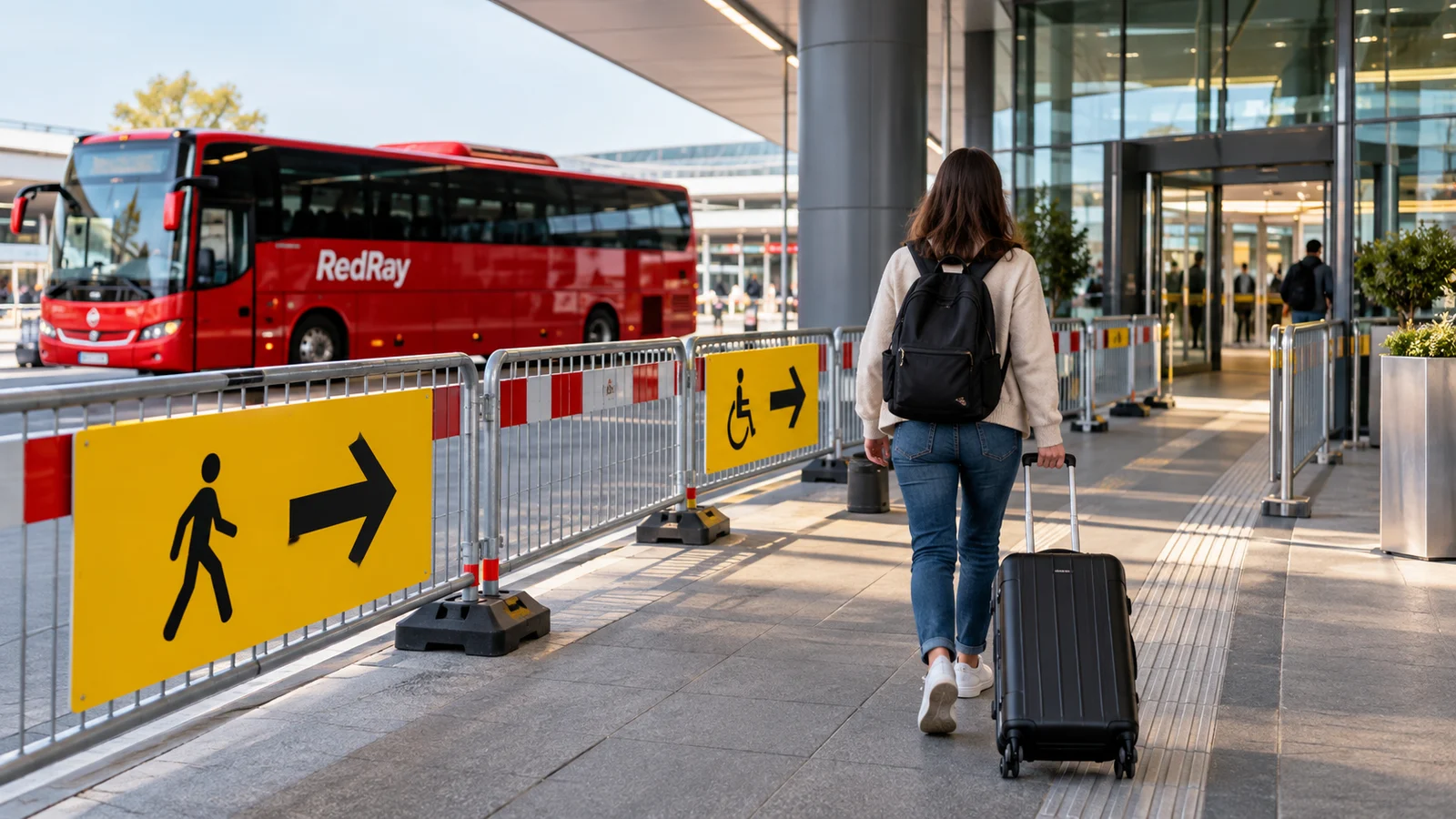
Access may be restricted for various reasons: different opening arrangements, repairs, temporary traffic management or a closed part of the complex. This article does not establish the reason at a particular station or guarantee an alternative route exists. It helps you check access on site and contact responsible people without risking your safety for a shortcut.
First make sure you are at the right complex
Compare the address in your current ticket and the carrier’s latest confirmed messages. A large city may have several terminals, similar names and separate buildings within one transport hub. Closed doors do not always mean changed opening arrangements: sometimes the passenger is at another entrance or facility. Check the complete address, not just the map name.
Do not use a photo from a previous trip as your sole instruction. The building may look the same while the route to the platform has changed. A map may also mark the centre of the site instead of an authorised entrance. Check against current passenger signs, an official announcement or a responsible employee.
If a new address arrives through an unclear channel, do not relocate automatically. Check the source and connection to your service. A changed entrance at the same station and boarding moved to another district are different situations. Clarification needs a specific place, not just “from the other side today” without a clear landmark.
Read the notices at the entrance
Stop somewhere safe without blocking the doors or pavement and inspect notices, arrows and a diagram. Check for a date, access hours or a marked alternative route. Do not follow the first person entering through a staff passage: they may be an authorised employee rather than following a passenger route.
If the notice is in an unfamiliar language, translate the short relevant part without photographing unrelated documents or people. Machine translation may help with an arrow’s direction, but ask staff if ambiguous. Do not interpret a word you do not understand in favour of the shortest path through a barrier or vehicle lane.
Distinguish official signs from casual advice. Someone hurrying nearby may be heading for another bus or using old information. If advice conflicts, ask station or carrier staff. Ask for the authorised route specifically for a passenger with a suitcase to the required boarding area.
How to ask a precise question
State which entrance you are at, name the service or platform required and mention your luggage. Ask for the official pedestrian approach: from which street, through which doors and past which landmarks. “Go around the building” may be insufficient for a large complex. Clarify immediately which side and whether there are steps.
If you need a step-free route, say so directly. Do not assume every alternative entrance is accessible with a large suitcase, pushchair or mobility aid. Ask staff to check the actual current route and possible assistance. A lift on an old diagram does not guarantee it works or leads to the right area today.
When carrier support answers, describe the actual situation: you are at a closed entrance, the current time and that the permitted alternative route is unclear. Do not simply write “the bus station is closed” if you see only one closed door. A precise description helps distinguish a site-access problem from relocation or cancellation of a particular service.
Assess the alternative before pulling your suitcase along it
Check whether the route follows pavements, authorised crossings and accessible passenger areas. If it requires walking between moving buses, through a barrier or along a dangerous verge, do not use it at random. Ask responsible staff for another official option or assistance. A visible bus does not mean a direct approach is permitted.
In rain, darkness or icy conditions, a shorter route may be harder with luggage. Do not run on stairs while holding a phone map in front of your face. Stop at a safe point, read the next part of the route and only then move. If you need a companion’s help, agree who leads, who controls the suitcase and where to meet again.
Do not leave belongings unattended at the old entrance while searching for another. Do not give them to a random person offering to “take them through the back”. If you need official storage, separately check its conditions and luggage collection. For a short detour, reducing simultaneous tasks is better than losing control of your belongings.
If there is little time before departure
Tell the carrier or responsible employee where you are and which obstacle arose. Clarify possible actions, but do not assume the bus will definitely wait. Sending a message does not itself change departure time. Equally, silently trying to run through a prohibited area creates risk and does not help verify boarding.
If offered another joining location, ask for clear confirmation that it is agreed for this service and your document, and how to reach it safely. Do not independently choose the nearest stop on a map. A scheduled operational stop or parking place is not necessarily a passenger boarding point.
If you actually miss boarding, record your chronology and contact the seller about available options. Do not assume an automatic refund because doors were closed or you have a notice photograph. The circumstances, purchase conditions and instructions received need consideration. Safety and realistic alternative travel remain priorities while payment questions are resolved separately.
If travelling as a group
Do not send people to search different entrances without agreement. In a large complex, this can turn one access problem into lost contact between participants. Choose a safe waiting point, someone responsible for clarification and a way to pass on the verified route. Do not randomly change arrangements for children or people needing accompaniment.
Once the alternative is confirmed, send one current instruction to those still approaching. State that the previous entrance is not in use and name the new landmark. Do not forward only an old map saying “you will work it out there”. If the route has important steps or a crossing, mention them without glossing over the difficulty.
At the end of the detour, check the required bus or platform again. Entering station grounds does not mean the search for the service is complete. After hurrying, it is easy to board the wrong vehicle on seeing a familiar colour. Give the date, route and document to the responsible employee and keep control of your belongings during loading.
What to retain for the future
If the alternative route was temporary, do not turn it into permanent instructions for every subsequent journey. Keep the date and context, and check access again before another service. Someone else’s notice screenshot from last month does not confirm today’s terminal arrangements. The same applies to your own experience from the previous night.
Allow time to find an authorised entrance on the next trip, particularly when arriving with luggage at an unfamiliar large complex. No universal number of minutes suits every station. Check the specific address, access hours and carrier’s instructions. Your buffer should reflect the actual approach, not just the distance to a central map marker.
Questions and answers
Do closed main doors mean the service is cancelled?
Not necessarily. First establish whether there is an official passenger alternative and whether arrangements for the specific service changed. Do not judge the whole station from one entrance.
Can I use the bus gates if I can already see the vehicle?
Do not use a vehicle or staff entrance without appropriate permission. Ask for an official safe passenger route and follow staff instructions.
Navigation shows a route through a barrier — what should I do?
Do not treat a map line as permission. Check the route against current signs and with a responsible employee, particularly if you need step-free access.
Will the bus definitely wait if I reported the closed entrance?
There is no such guarantee. State your exact location and obstacle, clarify available actions and do not risk your safety trying to make it through a prohibited route.
Useful links
Check contacts for your service on the RedRay website, and boarding and connection advice in the RedRay blog. Clarify opening hours and the actual alternative route with the particular terminal or carrier; this article does not guarantee any entrance’s accessibility.