

The bus has been standing in the border queue for a long time, and a visible building with a toilet seems close by. You are ready to get off when the vehicles ahead start moving. The usual advice to “return before the break ends” does not work here: there may have been no separate break at all, the bus may move and the way to the building may cross an area with different access rules.
Do not hide an everyday need until the last moment. Turn it into a clear request, however: whether leaving is possible now, who authorises it, which route is permitted and where to return. This article does not guarantee a toilet’s existence, opening or a right to walk away from the bus independently. It helps coordinate a specific action without an unsafe search for a shortcut.
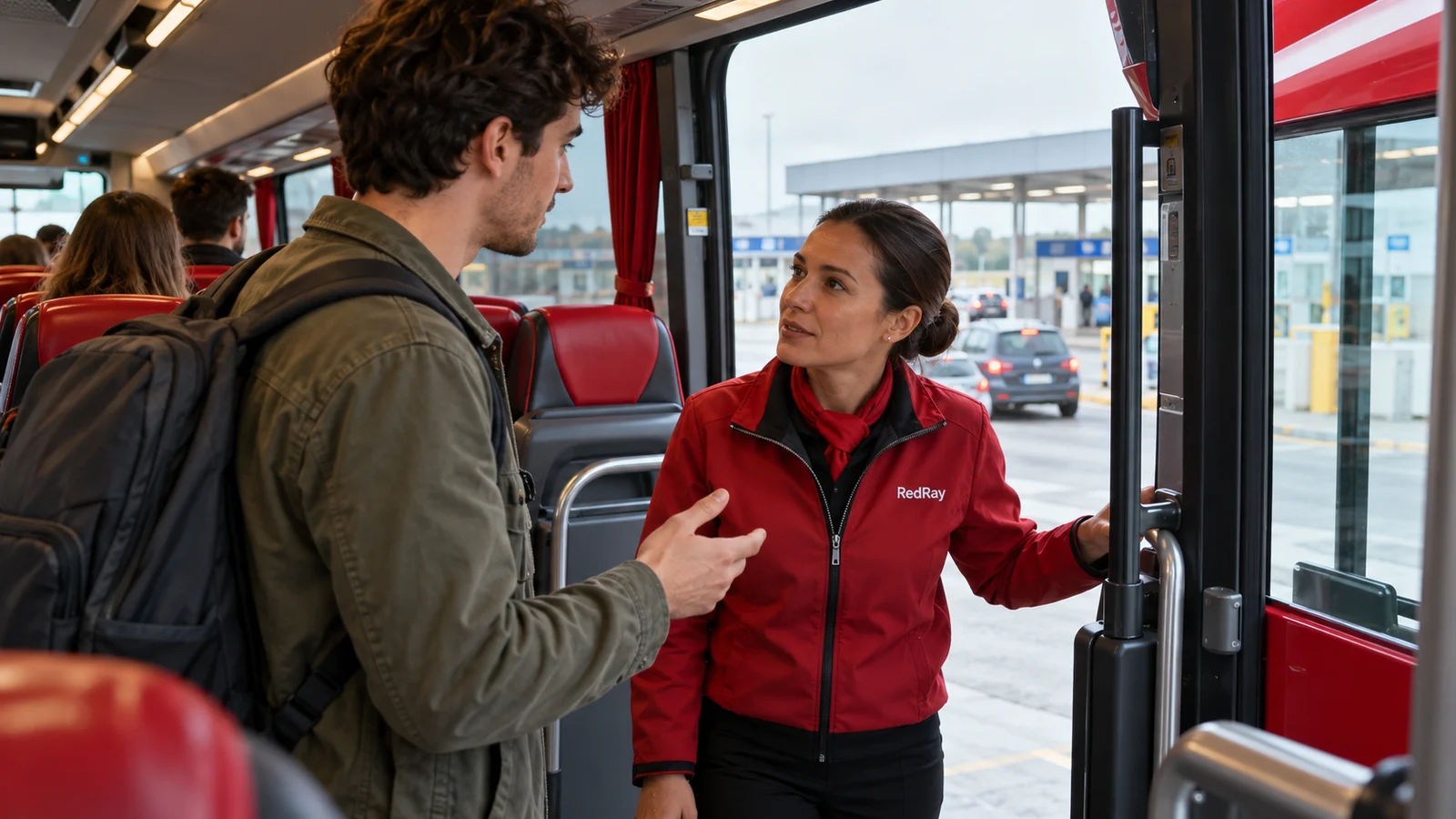
A border queue is not always an ordinary stop
First establish where the vehicle actually is: on the approach, in an authorised waiting place or already within the crossing. Do not judge only by a visible barrier. If boundaries or rules are unclear, ask a crew member and, for a controlled area, the responsible official through an available method. A location described in someone else’s post does not explain today’s situation.
For a Ukrainian crossing, the official procedure restricts independently leaving and boarding a vehicle without permission from representatives of the state border protection unit. A companion’s agreement or already-open doors must therefore not be treated as sufficient authorisation. This is a specific Ukrainian security rule, not a description of every queue in every country.
Outside the crossing, do not step into a traffic lane at random either. A stopped bus remains a vehicle on a road or parking area, not automatically a safe pedestrian zone. Discuss the possibility and conditions of leaving with the crew. If you are unsure which rules apply, clarify the location and responsible person before trying to reach the nearest building.
Make the request before getting off
Say briefly, without unnecessary disclosure: “I need the toilet. May I get off now, and how should I return?” If you need accompaniment or help with steps, say so immediately. You do not need to explain health details to the entire passenger compartment. The responsible person needs to understand the practical need and whether it can be met under current conditions.
Ask not just for a direction but the complete permitted procedure: which door to use, where to walk, which facility to use and how to report your return. “Over there on the right” may be insufficient if a barrier or several traffic lanes lie between you. Repeat the key part in your own words, especially in noise or an unfamiliar language.
If the response is “That still needs checking”, it is not agreement. Stay in the agreed place and establish who will tell you the result. Do not open other doors yourself or silently join a passenger permitted to take a separate action. Their circumstances and return route may not apply to you.
Check actual access, not distance
A visible toilet may be closed, belong to another part of the complex or have an approach you cannot currently use. Do not promise yourself a quick return merely because you can see the building through the window. Ask for confirmation of an available facility and permitted route. If a particular service has conditions of use, establish them on site rather than relying on general assumptions.
Separately consider whether you can get there without crossing between moving buses, climbing a barrier or stepping onto an unsafe roadside. If a suggested landmark is unclear, ask before starting. A nearby facility does not become accessible because a navigation app draws a straight line to it. Do not use a map as permission to cross a restricted area.
If you need a step-free route or other assistance, say so directly. Do not assume every available toilet matches your abilities. Accompaniment arrangements and control-area rules are separate matters that need coordination. Preparing for physically difficult disembarkation is covered in the article on assistance when leaving the bus for checks.
Agree your return if the queue moves
Ask whether the bus may move during your absence and how you would obtain the current return location. Do not demand a promise to remain in one place regardless of officials’ instructions. You need to know who is tracking your absence and how to pass on an update, not simply hear a reassuring “We are here”. An ordinary timer does not track vehicle movements.
Establish an available contact for the responsible person and how you are permitted to use it. Your phone may have no network, and actual instructions may restrict its use in a particular area. The arrangement must not depend on an unknown number belonging to a random passenger. If electronic contact is unavailable, ask staff for an acceptable notification procedure.
Do not rely only on a companion who “will see you through the window”. They may fall asleep, move to another part of the bus or not know whom to inform. A private family arrangement is useful, but the responsible party must also know about the agreed departure. Equally, you need not tell the whole group the reason: the fact and established return method are enough for coordination.
Take what you need without excessive repacking
Prepare documents and personal belongings that should be with you in your circumstances before leaving your row. Do not leave your passport on the seat to stand up faster or hand it to a random neighbour. If the original is already with the responsible service, clarify the procedure for that specific situation. Its temporary absence from your hands does not create permission to leave.
Reduce the number of separate items you need to hold, but do not bury your only phone with the contact at the bottom of a large suitcase. A small closed bag containing the necessary set is more convenient than a folder, wallet and charging cable in different hands. Do not spread belongings on other people’s seats intending to retrieve them later after the passenger compartment or bus location has changed.
If leaving with a child or an adult who needs accompaniment, agree the departure of everyone involved. Do not assume permission for one person automatically extends to the whole party. Everyone must understand their route, and a child must not search for transport independently in a moving queue. Do not replace care or health questions with general advice from this article.
What to do on the way back
Return by the permitted route to the agreed point. If you see the bus has moved, do not chase it across traffic lanes or take a shortcut towards its visible side. Use the agreed contact method or speak to the responsible staff member from a safe, permitted place. Seeing the vehicle does not mean you can safely reach its door.
If access changes or traffic is arranged differently ahead, stop at a safe point and clarify the next action. Do not try to return to a previous control area contrary to instructions. Identify your bus and explain that leaving was agreed, without inventing permission for any return route. A precise explanation is better than demanding passage because you are in a hurry.
After returning, tell the person who was tracking your absence. Simply getting on and sitting down is insufficient if the crew or coordinator still expects confirmation. Check your own documents and bag. Do not pass on unchecked advice that “Everyone can get off there”: your permission and circumstances are not general instructions for the rest of the bus.
When leaving has not yet been agreed
Ask for the next available option: whether to ask again later, whom to contact and exactly what still needs clarification. Do not conclude there is no toilet at all if only current access is unclear. Equally, do not interpret no answer as silent agreement. It is better to state the problem directly than leave secretly and create uncertainty for the crew.
If the situation changes and urgent help is needed, tell responsible staff immediately. Do not wait to finish an everyday checklist or choose self-treatment from others’ advice. This text does not determine medical urgency or replace professional assistance. Its scope is organising permitted movement, access and return to the bus.
Questions and answers
If the bus is stationary, can I simply leave through an open door?
No. An open door does not itself explain the permitted procedure. Clarify whether you may leave, who authorises it and the return route in light of the bus’s actual location.
Is a passenger’s tip about a nearby toilet enough?
It can prompt a question, but does not confirm that the facility is open or currently accessible. Do not cross controlled or traffic areas solely on someone else’s memory.
Will a phone alarm stop me falling behind the queue?
It reminds you of the time, but does not show where the bus moved or whether you can reach it. Agree the return point, contact and update method before leaving.
Do I need to report my return if the crew has already seen me?
Confirm your return under the agreed procedure rather than relying on an assumption. A brief message to the responsible person helps close the record of an authorised departure without searching for someone already seated.
Official procedure and limits of this advice
For the Ukrainian security basis, see the procedure for establishing security arrangements at border crossings. The relevant provisions were checked on 23 October 2026. Clarify another country’s procedure with its competent service. Other practical articles are available in the RedRay blog; no general article confirms a toilet’s availability, permission to leave or a specific waiting time at your crossing.