

A small leather item or decorative shell catches your eye at a market. The seller assures you it is only a souvenir and customers take such gifts home every day. That answer is insufficient for an international bus passenger. Establish the species the item comes from, its origin and the documents required for your actual route.
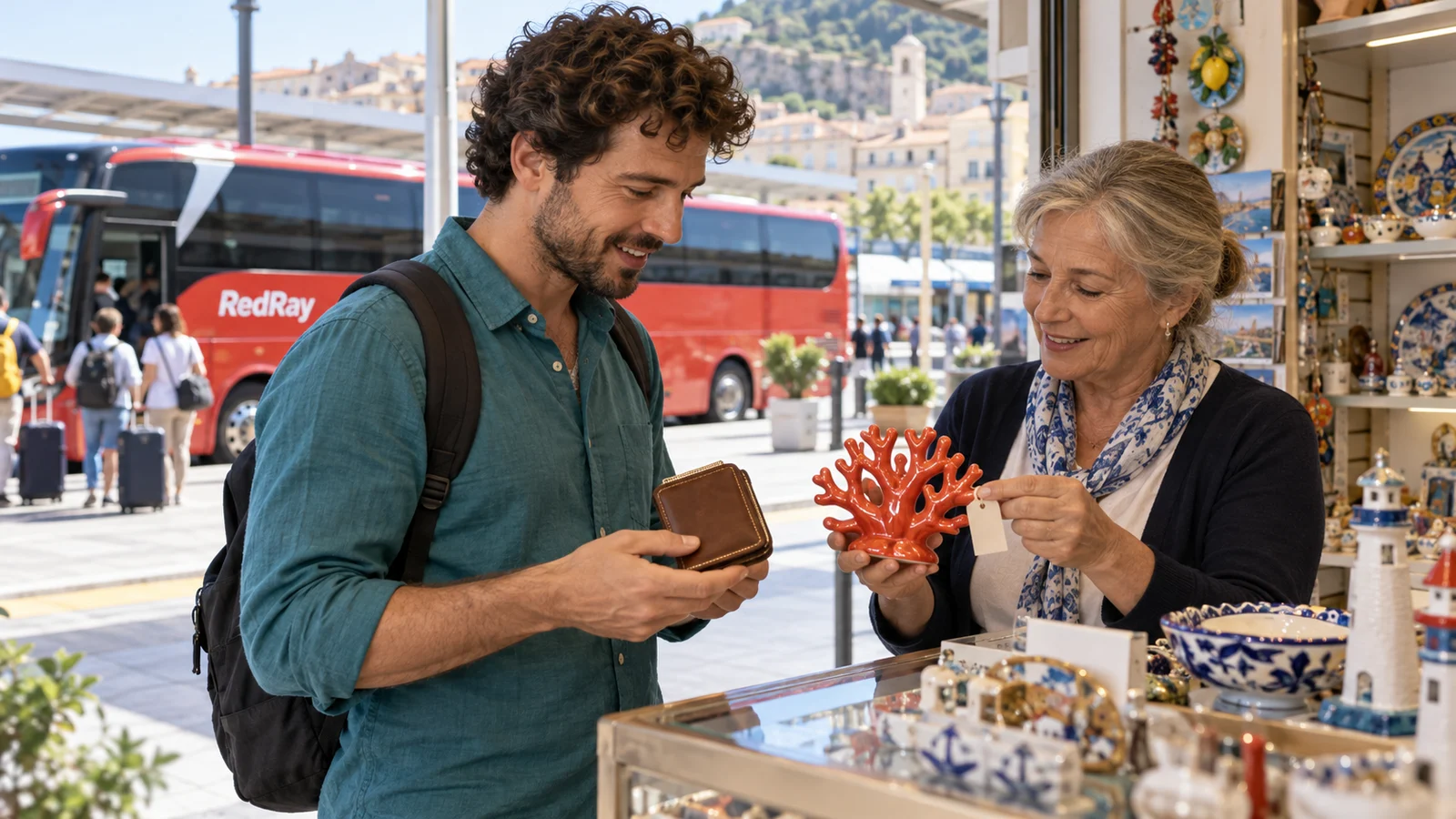
The point is not to find a way to hide a purchase among clothes but to decide before paying whether your service can carry it lawfully and practically. Small size, personal use or a “gift” label do not themselves answer that. If the necessary information is unavailable, not buying may be the only clear decision without unjustified risk.
Start with the material, not the price
“Natural leather” does not identify the animal, and “shell” does not identify the mollusc species. Ask for a precise material description, known scientific species and origin. For a composite item, ask about each natural component: an insert, decoration, handle or lining. An ordinary-looking product does not exclude special requirements for one component.
Do not determine legal status yourself from a similar search photograph. An image can accompany a specific enquiry to the competent authority but does not replace an accurate description. If the seller only says “everything is legal”, ask for clarification before paying. Refusal to identify the material is a reason to stop, not choose the most convenient explanation yourself.
What CITES covers
CITES concerns international trade in protected species; attention may be required not only for live animals or plants but also certain parts and products. Requirements depend on the species, movement circumstances and applicable rules. Do not declare all leather goods prohibited or, conversely, assume every finished souvenir is uncontrolled.
The official Swiss FSVO souvenir guide explains that protection restrictions may apply to both purchased items and those found in nature. Its exceptions have their own conditions. Do not apply them to another country or species without checking: the Swiss example is not universal permission for every bus border.
Prepare a specific enquiry before buying
Make a short item record: product name, material, known species, quantity, seller, country of purchase and intended use. Add a photograph of the item and markings if you can take it lawfully without others’ personal data. Separately record unknowns. Do not fill gaps with seller statements unsupported by evidence.
- Does the described item fall under protection rules for this species?
- Which documents are required for export, import and relevant transit?
- Are there conditions concerning purpose, lawful origin or advance processing?
- Where can the necessary formalities be completed on the overland route?
Ask the authorised body in the relevant country, not only the shop or ticket seller. A carrier can explain its route and luggage conditions but does not classify a product under species-protection rules. Keep the authority’s reply with your enquiry: without the item description, general advice may later appear broader than intended.
Do not merge different customs stages
Draw the actual bus route showing departure, possible transit and entry countries. Permission to export does not automatically confirm permission to import into the next country. The same applies to the return route. If the item travelled with you before, do not treat that journey as evidence that every current requirement is met.
Clarify the actual route with the carrier before paying. A service’s commercial name showing two end cities does not always describe every country en route. If the route changes after your checks, revisit the formalities. Do not silently apply clearance for one sequence of countries to another.
Receipts and permits serve different purposes
A receipt helps link an item to its purchase but does not itself answer every CITES question. Do not rely on an arbitrary shop certificate with an attractive heading either. Understand who issued it, which item it covers, which operation it authorises and how it must be presented.
The Irish NPWS describes CITES permit procedures, certain personal belongings and checks at designated customs locations. This shows why format and timing must be established beforehand. Do not expect the necessary document to be issued beside the bus or assume a photograph replaces a required original.
Check that formalities fit the bus service
After the authority replies, compare the required inspection location and procedure with the bus’s actual checkpoint. Ask the carrier whether the service goes there and whether the agreed formalities fit the journey. Do not ask the driver to change an international route arbitrarily for a purchase you left unchecked until the last day.
If the necessary steps cannot be completed on your route, that is a separate reason not to take the item. A border open to passengers is not necessarily suitable for every special goods procedure. “Buses go through there” is no substitute: compare passenger movement and processing of the particular item specifically.
Deciding when information is missing
Consider an illustrative situation: you know your bus date but the seller cannot identify the leather species. A new cover or a written shop promise does not close that central gap. Do not buy planning to “sort it out in the queue”. Choose a souvenir made from an identifiable material that avoids this uncertainty, or postpone the decision until checks are complete.
If already purchased, ask the seller about permitted return or storage options without inventing a guaranteed right to them. Posting it yourself or giving it to another passenger does not remove protection requirements. Other delivery methods have their own rules, and another suitcase does not change the goods’ properties.
If the question arises during control
Show the actual item and documents to an authorised employee and explain origin and purpose without invented details. Do not dismantle it, secretly discard it or change its owner during checks. If a separate decision is needed, ask which document is issued, whom to contact subsequently and what you may do next.
Coordinate bus contact separately with the crew. Do not announce a completion time yourself or promise others only a few minutes’ delay. Keep available evidence, but do not photograph the control area against its rules. A legal issue about an item cannot be resolved by rushing because of a timetable.
How this relates to ordinary luggage
Only after establishing lawful movement should you address dimensions, protection and placement in the bus. For related questions, read about documents for new purchases on a return bus and souvenir weight before returning. Luggage approval does not replace a special permit, and a permit does not create additional space in the hold.
Sources checked on 23 October 2026. FSVO and NPWS guides explain distinctions between material, origin and permit procedures, not provide ready-made permission for your service. Before buying, recheck requirements with the competent authorities of the actual route countries using a precise product description.
Questions and answers
If a leather item is used, are checks unnecessary?
Do not conclude this solely from its condition. Species, origin, previous movement and the relevant country’s rules matter. Describe the real circumstances to the authorised body and establish which evidence this particular item needs.
We found the shell on a beach. Is it not a personal belonging?
Finding it does not itself exclude protection restrictions. Do not take a natural object for bus transport before identifying the species and local collection and movement rules. Purchase and discovery differ, but neither provides a universal exemption.
The seller offers a receipt without naming the material. Is that enough?
Such a document may omit the main information needed to check species and requirements. Ask for a truthful specific description, not a convenient generalisation. Do not request deliberate mislabelling to make transport easier.
Can I give the souvenir to a friend taking another bus?
Transfer does not remove requirements and may change the circumstances underlying earlier advice. Do not use another passenger to bypass checking. Establish the lawful procedure for the actual owner, person carrying the item and route first.
If import is allowed, can I skip checking the return?
No. A permit or advice for one movement does not necessarily cover the next export or re-entry. Keep earlier processing documents and ask about the new route before returning. Pay particular attention to changed transit and the required control location.