

An international bus policy says pets are not carried, but you need to travel with a guide dog. Do not decide from that line alone or buy an arbitrary extra passenger seat for the dog. First check separate passenger-assistance provisions, the evidence recognising the dog’s status and veterinary procedures in the countries along the route.
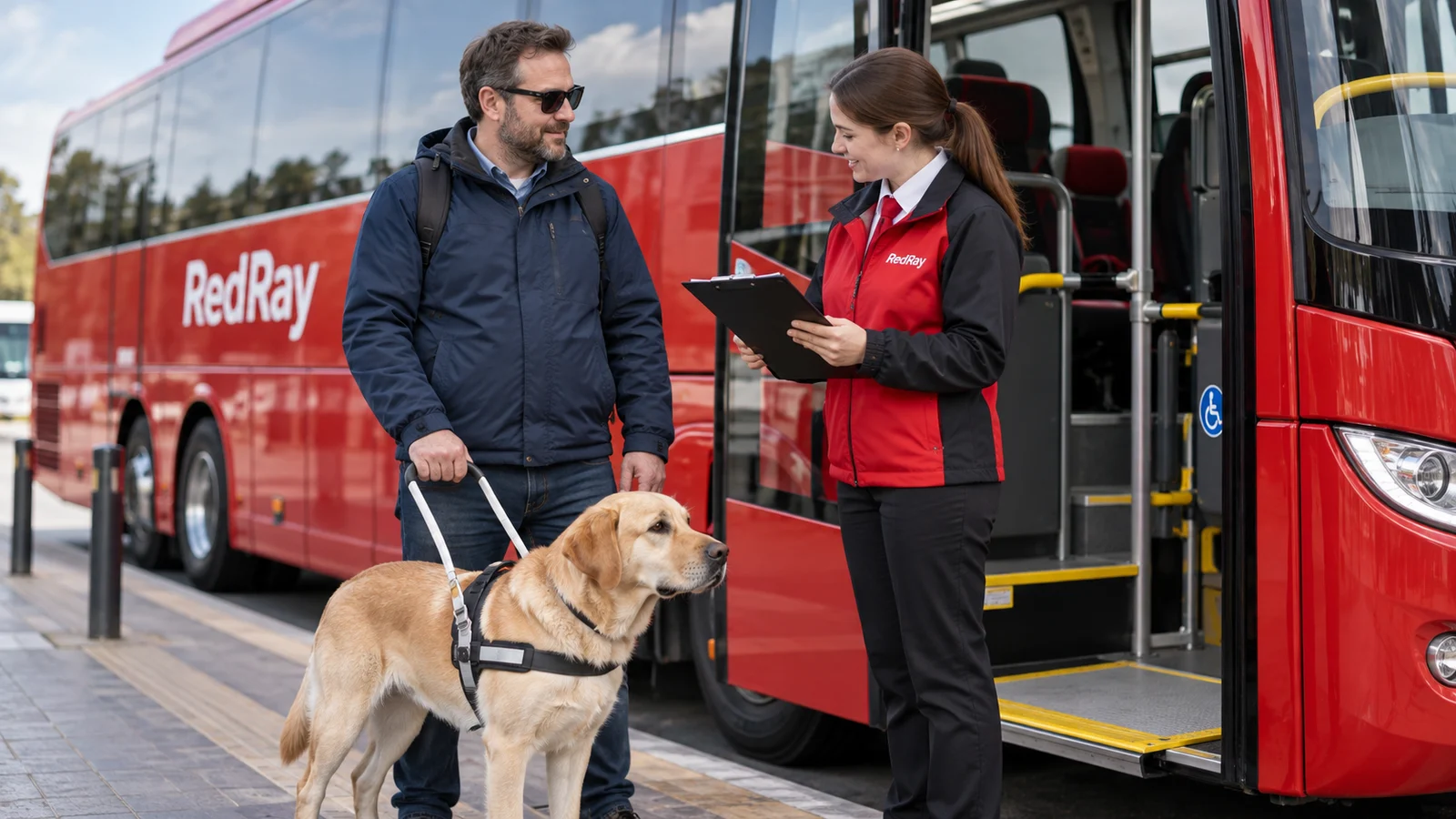
Permission to use a dog’s assistance in transport and permission for the animal itself to cross a border are different questions. A carrier’s reply does not replace veterinary documentation, and veterinary papers do not automatically establish assistance-dog status. Coordinate these two independent levels before irreversible travel expenses.
Distinguish assistance dogs from the general pet policy
Find the carrier’s section on passengers with disabilities, guide dogs or assistance dogs. A general pet restriction may have separate provisions for recognised dogs assisting a person. Do not ask for your need to be assessed under an ordinary pet-carrier weight list if another procedure applies.
Equally, a labelled vest bought online or personally describing a dog as “emotional support” does not establish recognised status in every country or network. Check which dog category the applicable rules recognise and how it is evidenced. Do not use fictitious certificates or rename an ordinary pet to bypass a restriction.
For travel with an ordinary pet, see the separate article on agreeing pet transport. This article does not repeat its carrier-selection advice: its main purpose is arranging necessary passenger assistance correctly without confusing it with veterinary admission.
Describe the exact bus route and assistance needed
Contact official support before purchasing if the answer determines the service’s suitability. Give the date, boarding and alighting points, actual carrier and all bus segments. With a connection, the first operator’s reply alone does not explain the second’s arrangements. Ask about the return as well if it differs.
Describe the need specifically: you travel with a guide dog or another recognised assistance dog and need boarding, placement and assistance arrangements confirmed at a particular stop. Explain whether you need meeting at an agreed point, help navigating the terminal or accompaniment to the bus door. Do not expect one booking checkbox to describe every action.
Check the applicable assistance-notification deadline and who confirms arrangements. Do not turn one carrier’s recommendation into a universal deadline for every country. Save the enquiry reference and reply in an accessible format you can use independently at boarding rather than rely on a companion’s only screenshot.
Check status documents, not only an external label
Ask which evidence your circumstances require, whether your issued document is accepted and how to present it. The enquiry must concern a particular document and service. “Guide dogs are allowed” is useful but does not yet explain how to establish status to the crew, especially for a document issued abroad.
Do not assume all private certificates are automatically mutually recognised. If the answer is ambiguous, ask for the applicable requirement and clarification concerning your document. Establish necessary translation, certification or further evidence before travelling; do not buy an unverified “international licence” from a random seller because of its impressive name.
For example, Polish government guidance on assistance dogs describes proper training, identification and status certification and links them to access rights, including public transport. This explains why an unofficial label alone is insufficient, but does not automatically settle every foreign document’s status.
Send only information needed to assess the enquiry through a verified channel. Do not share a complete medical history in the service’s general chat. If excessive information is requested, clarify its purpose and necessary scope. Show documents to the responsible boarding employee, not everyone in the queue.
Read country-specific exceptions in network conditions
Even a large international network may have general rules and supplements for particular countries or operators. The FlixBus conditions of carriage address ordinary animals and assistance dogs separately, with country-specific provisions detailing requirements. This illustrates the structure of rules, not a claim that all RedRay buses follow them.
Check the muzzle, harness and document arrangements applicable to your segment. Do not transfer an exception read for one country to another: wording may differ even within one network’s country sections. If support contradicts published terms, ask for reconciliation before travelling rather than expect to resolve it in the doorway.
Separately ask how the dog’s presence is recorded in the booking and whether additional confirmation is provided without buying a standard seat. Do not pay unnecessarily on an assumption. Equally, do not expect the same procedure and evidence in every country: applicable rights and proper proof of status matter, not another passenger’s experience.
Veterinary preparation remains separate
The Your Europe page on travelling with pets explains checking requirements by departure and destination country. Entry from outside the EU and movement within it may involve different documents and procedures. Do not describe any veterinary passport as sufficient for every international route.
With an official veterinarian, check the dog’s identification, validity of required vaccinations, possible tests, treatments and appropriate document for the direction of travel. Clarify the process with the competent authority of first entry and check transit requirements. Some procedures cannot be completed in the final hour, so a carrier saying “space is available” does not establish border readiness.
Check the permitted entry point for your procedure and whether processing fits the actual bus route. Do not demand a driver choose another border because you failed to check documents in advance. If importation requires special steps, establish whether a scheduled bus journey accommodates them rather than expect the whole group to wait indefinitely.
Do not rely on old announcements of temporary simplifications for animals from Ukraine. Their scope may have been limited and changed. Do not interpret guide-dog recognition yourself as exemption from veterinary requirements either. Check the return separately: a successful earlier entry does not answer every question about the next crossing.
Agree actual space and arrangements during the journey
Ask how the dog will be placed near the passenger without obstructing aisles, exits or equipment. Do not assume paying for the neighbouring seat permits placing the animal on it. Agree the actual cabin space, legroom and access to the door with the carrier within safe and applicable arrangements.
Prepare a small accessible bag with permitted care items, water and cleaning supplies. Discuss the dog’s needs and health advice with the professional supporting it rather than experiment with sedatives recommended by passengers. This article does not prescribe an individual veterinary plan for a long journey.
Before a stop, ask whether leaving is permitted, how to return and whether a safe suitable area exists. At a border, agree any exit with responsible services and the crew; the dog’s need does not permit leaving a controlled area independently. If the usual arrangement is impossible, raise the need early to obtain permissible instructions.
What to do if a disagreement arises at boarding
Show your enquiry confirmation and applicable documents, explaining this concerns an assistance dog rather than ordinary pet transport. Ask staff to contact responsible support and clarify the specific reason for the problem. Do not put the dog in the luggage hold as an improvised way around the disagreement.
If transport is not confirmed, ask for a specific explanation and available alternatives. Distinguish unconfirmed status, a veterinary problem and a stated safety obstacle: “animals are not allowed” does not explain every situation. Do not accept ordinary voluntary cancellation without understanding its consequences for your enquiry.
The official Your Europe page on rights of passengers with disabilities or reduced mobility explains bus assistance and permissible grounds for restrictions. It helps frame an enquiry correctly but does not replace assessment of the particular service. For a physical boarding problem, see the separate article on an agreed lift that is not working.
Sources for this article were checked on 23 October 2026. Keep current carrier and veterinary-authority replies beside your ticket in an accessible format. Check them again before another journey: country-specific procedures, the actual operator and route may have changed.
Questions and answers
Does a pet ban automatically ban guide dogs?
Do not conclude this without a separate check. Read recognised-assistance-dog provisions and applicable passenger rights, and establish how to prove status for this particular transport.
Does a vest replace a certificate or other necessary evidence?
A label alone does not establish compliance with every country’s requirements. Clarify recognised status, documents and their checking procedure. Do not buy an arbitrary “international” document without verifying its significance with the competent authority.
If support approved boarding, are veterinary documents no longer needed?
No. Confirmation of bus arrangements does not replace border admission. Check identification, vaccinations, possible tests and appropriate documents separately with competent veterinary services for the actual countries.
Do emotional-support dogs always have the same rights?
Do not assume automatic equivalence. Establish the category recognised by applicable rules and proper evidence. A personal need for an animal’s presence does not itself settle its status on an international bus.
Can I buy a standard seat for the dog and arrange nothing else?
A passenger ticket does not replace assistance procedures or permission to place an animal. Ask for the correct booking process and safe space near you. Separately prepare veterinary documents for the border.