

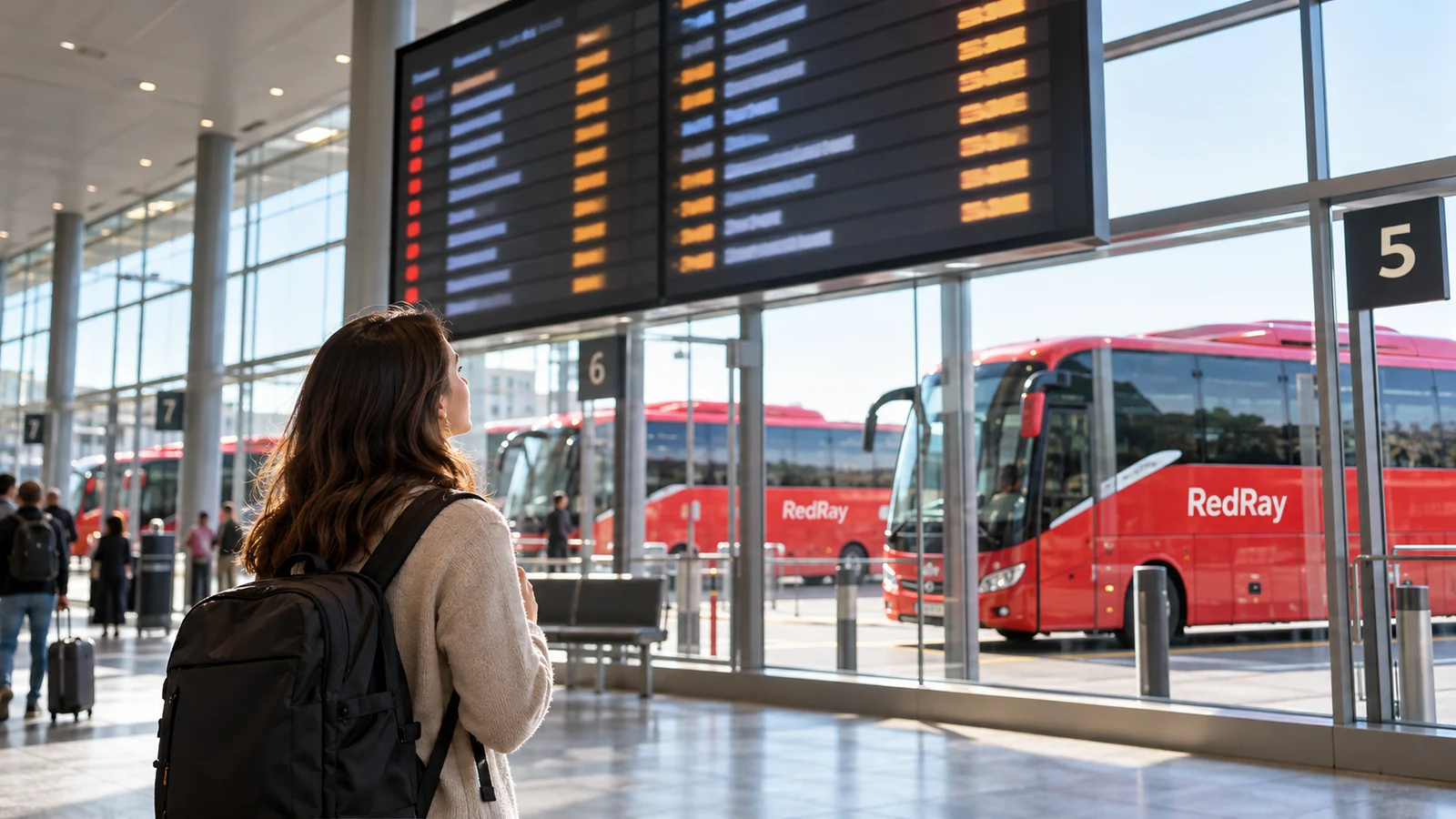
Your ticket names the city you need, but it is missing from the board. Unfamiliar termini, several similar departures and platform numbers appear instead. This does not yet mean cancellation: your city may be an intermediate stop while the screen shows another part of the route. Equally, do not board the first bus travelling in the right direction without checking.
Systematically compare the specific service, time, carrier and confirmed boarding point. This is not a general guide to departure-board terminology, but a search procedure for when your city’s name does not help. The aim is to identify the correct departure using several independent details and confirmation from the responsible party.
Make sure you are looking at the correct board
A large terminal may have separate screens for arrivals, departures, local and international services. Check what your chosen screen displays. Your bus number will not appear in a different category merely because its platform is nearby. Do not use a neighbouring terminal’s screen as evidence that your service is missing from your stop.
Check the date and time. Some screens display only imminent departures, and data may change or rotate. Do not conclude from one quick glance, particularly if your service is outside the visible time window. But do not wait indefinitely: if boarding is near, contact information staff or the carrier’s known contact.
Check that you are at the agreed boarding location. A city may have different bus stations, separate platforms beside a railway complex and stops outside a terminal. The ticket, map and latest confirmed messages must refer to the same point. If they conflict, establish the address before guessing which line on the board is yours.
Open the complete ticket, not just the city name
Find the service number, carrier, date, time and departure address. If a terminus or full route is provided, note it separately. Booking systems do not all display the same fields, so do not invent missing details. Ask the seller or carrier which information identifies this particular departure.
Distinguish a booking number from a service number. Your personal purchase reference may be needed by support, but does not have to appear on a public board. If you are searching for a long email code and cannot find it, ask what it identifies. Likewise, a seat number is not a platform number even if both have two digits.
For a connecting journey, open the document for the required section. Your final city may not match the first bus’s route at all. Searching with the wrong coupon means comparing the board against another departure. When speaking to staff, identify the part of the journey you are boarding now.
Why an intermediate city may not be the main label
Imagine a route through several cities with yours in the middle. A short board entry may use the terminus or another abbreviated service label. This is a possible explanation, not a rule for every terminal. Ask which label matches your service rather than assuming any bus travelling that way will take you.
A city’s name may also differ by language or accepted spelling. Compare it with other details rather than relying on rough similarity. Do not accept an unfamiliar label just because its first letter matches. If unsure, show staff the complete ticket name and ask whether it is an intermediate stop on the displayed departure.
Do not use a general map route as final confirmation of boarding. Two buses may use similar roads but have different stops and booking rules. Your purchase concerns a specific departure. Match it to the actual platform and responsible person rather than merely finding a vehicle travelling in the right direction.
How to ask at the information desk
Show your ticket without handing over unnecessary documents and say: “My city is an intermediate stop. Please tell me which name and platform this service is displayed under.” Give the date, time and carrier. If staff ask for a number, clarify which reference they mean so you do not give your personal purchase number instead of the service number.
If information staff cannot find the departure, ask whether it uses this terminal or a separate boarding point. Do not immediately infer cancellation. Compare the response with your document and contact the carrier officially. Send your current address and briefly describe the discrepancy.
Do not give a full ticket to random people in the hall promising to locate the bus through their own chats. For directions, you can show the necessary line without publicly sharing the code or personal information. Resolve booking validity and changes privately with the responsible party. Another passenger’s advice may help but does not replace confirmation.
Checks beside the platform
Match the actual bus to the confirmed service details. Before handing over luggage, tell the crew your required stop and show your document. A final-city sign on the vehicle alone does not explain whether passengers for your stop are accepted on your ticket. Do not load your suitcase until it is clear this is the correct departure.
If several vehicles of the same carrier or with similar labels are nearby, repeat the date, time and boarding point. Do not choose by colour or an advertising photo. A replacement may look different, but the correct service is established by documents and responsible staff checks. Equally, a similar logo does not make any vehicle your bus.
If the platform changes, check a safe route and the update’s source. Do not run across traffic lanes at a stranger’s gesture. If departure is near, tell the official contact exactly where you are and that you cannot clearly identify boarding. Do not assume the crew knows about the problem without being told.
If details still do not match after checking
Describe the discrepancy specifically: one time on the ticket and another on the board; one address in the document and another given by staff; the crew not confirming your stop. Ask the carrier or seller to establish current arrangements. “The bus is not here” does not distinguish the wrong terminal from a changed departure.
Do not buy a second ticket merely because your city is missing from the screen. Check the original journey first. If time pressure leads you to choose an alternative, read its conditions separately and establish the old purchase’s status. A new payment does not cancel the previous document or automatically create a refund entitlement.
Keep your own timeline: when you arrived, where you looked for boarding, what official contacts said and the check’s outcome. Do not photograph others’ tickets or passenger lists as evidence. Your document, precise location and replies matter for an initial request. Once clarified, give companions one confirmed version rather than every guess.
Questions and answers
Does my city’s absence from the board mean cancellation?
Not necessarily. Check the correct board, date, time window and possible display under the terminus, then confirm the particular departure with the responsible party.
Which number should I look for on screen?
Clarify what the ticket references identify. Service number, booking number, seat and platform are different details, and a personal purchase code is not necessarily shown on the board.
If the bus passes through my city, can I hand over luggage?
First confirm that it is your departure and accepts your drop-off point and document. A shared direction does not make buses interchangeable.
What should I send support if searching has not helped?
The purchase number, date, time, carrier, your precise location and specific discrepancy. Ask for the current departure label and boarding point to be confirmed.
Useful links
Find other bus station articles in the RedRay blog, and check contacts for your purchase on the RedRay website. This article does not describe a universal board format or confirm a particular platform or service availability.