

Your family bought tickets for the same service, but checking the layout reveals some seats downstairs and others upstairs. Or a double-decker arrived instead of the expected vehicle, and familiar numbering no longer helps. Establish the actual arrangement and agree it with the carrier rather than occupying any empty pair of seats.
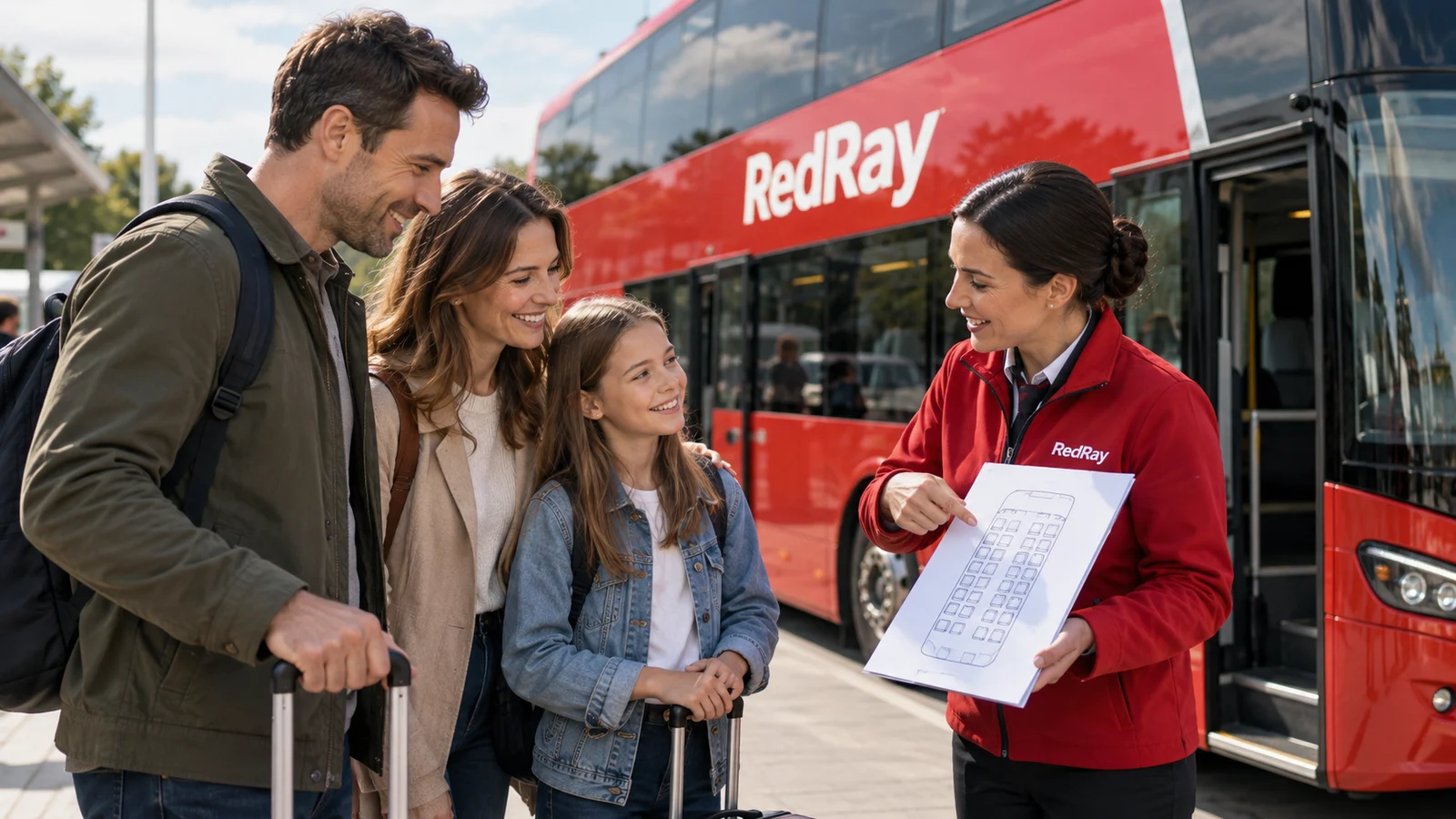
This differs from simply choosing the most comfortable seat. What matters here is supervising a child, accessing necessary items and a clear boarding procedure for the whole family. Tickets in one booking do not by themselves establish whether adjacent seating is included. Check the documents, purchase conditions and actual bus.
First check whether the seats really are on different levels
Do not infer the deck from the seat number alone. Layouts and numbering differ between buses, and a search image may need clarification for the specific vehicle. Open the complete layout, if available, and locate stairs and deck labels. If it does not unambiguously explain the arrangement, contact the seller or carrier.
Give the date, direction, ticket numbers and seat numbers. Ask directly: “Are these seats on the same deck, and will an adult sit beside the child?” Do not simply ask “will we be close?”: that might mean adjacent rows, opposite sides of the aisle or different levels. These are not equivalent for organising your journey.
If tickets do not state seat numbers, establish the seating procedure before boarding. Do not assume it depends on arrival order or that one adult can reserve every seat with belongings. The procedure depends on the service. Tell the responsible staff member about the family’s need, but do not present that notification as a confirmed change.
What to agree for a child
State the child’s age and actual supervision needs without unnecessary personal detail. Ask which permissible arrangement the carrier offers for your situation. Do not rely on random advice that a child “can sit upstairs alone”. Check accompaniment procedures, seat suitability and other requirements against the particular journey’s conditions.
Where two adults are travelling, one possible discussion is “one adult with the child, the other separately”. This is only an organisational option, not a guarantee that suitable seats exist. Do not swap tickets before agreement or treat two seats in different parts of the bus as interchangeable. Establish exactly which numbers are assigned to each person.
If the child needs additional equipment for safe travel, check its use separately before purchasing. Do not assume any child seat can be installed on any bus seat. Agreeing the deck does not replace checking compatibility and carrier rules. Likewise, convenient stair access is no reason to disregard safety requirements.
When the bus is replaced before departure
Show your saved tickets and confirmation of agreed seating. Explain what is essential for your family: an adult beside the child, avoiding frequent stair use or another specific need. Saying only “we wanted better seats” makes it harder for staff to distinguish a comfort preference from an accompaniment issue.
Ask the responsible staff member to show the actual seats and propose a permissible solution. If the layout changed, do not try to match seats yourself using a photograph of another vehicle. Do not move to someone else’s numbers because they were more convenient on the old bus. A replacement requires specific clarification understood by both family and crew.
If an arrangement can be made only after boarding finishes, ask where to wait and who will return with an answer. Do not separate children and their supervising adult into different queues without telling staff. Keep tickets and necessary documents accessible and belongings clear of the aisle. Do not demand departure before safe seating has been resolved.
Why not arrange a silent swap with random passengers?
Another person may have specifically chosen their seat for their own needs. They do not have to explain those needs or accept your offer. You can politely ask about a voluntary swap, but first establish with the crew whether this is allowed and how to agree it properly for the particular service.
Do not start moving people if staff do not know who will sit where. Even a friendly agreement between passengers may conflict with seat-recording procedures or others’ agreed arrangements. Be particularly careful on routes with intermediate boarding: a seat empty at the start may belong to someone joining at the next stop.
Do not leave bags on several seats to hold them until your discussion. This creates conflict and does not formalise a change. Make a specific request to the responsible staff member. If a swap is approved, repeat the numbers aloud and ensure everyone understands the same outcome rather than merely guessing.
How to organise belongings if adults sit separately
After agreeing seats, divide hand luggage according to needs, not merely who is strongest. The adult beside the child should have the child’s essential travel items. Do not leave documents in the bag of someone on another level if a check would require an urgent search. Equally, do not make unlimited copies containing personal information.
Agree communication at stops: who helps the child, who watches luggage and where to regroup after returning. Do not plan regular stair trips while moving as a substitute for appropriate seating. Messages can be used when safe, but a phone does not replace responsibility for supervision.
If an adult goes upstairs or downstairs at a permitted stop, do not leave the child without agreed supervision. Coordinate within the family first and, if needed, with the crew. Your plan must work without assuming an unknown passenger will automatically watch your belongings or child.
After each agreed change, check whether necessary items remain beside the previous seat. Changing seats within a vehicle can also lead to a forgotten phone, charging cable or child’s organiser. Move your own set systematically rather than leaving belongings in two parts of the bus simultaneously.
If no acceptable solution is offered
Clarify options before departure: another agreed seating arrangement, rescheduling or another option under the purchase conditions. Do not promise your family that every such case means a free replacement or full reimbursement. The outcome depends on what was booked, the circumstances and applicable rules.
Keep tickets, the earlier agreement, the vehicle replacement message and the specific boarding response. If you decide not to travel, establish how that decision is recorded and what happens to every passenger’s documents. Do not write “cancel everything” in a group chat if some family members intend to continue.
In a later complaint, describe the facts: which seats were purchased, what was confirmed, which seats were actually offered and why they did not meet the agreed need. Do not collect others’ passport details or photograph passenger lists. An accurate account of your own situation is more useful than a public argument over who should have given up a seat.
Questions and answers
Does one booking number guarantee family seats on the same deck?
Do not assume that without checking. Compare actual seats, layout and purchase conditions, and ask for the required arrangement to be confirmed.
Can I occupy an empty pair of seats beside my child myself?
Contact the crew first. Empty seats may be assigned to other passengers, including those joining at the next stop.
How should I explain the need after a bus replacement?
Show the documents and earlier approval and state the specific need, such as an adult beside the child. Ask staff to check the actual layout and offer a permissible arrangement.
If adults sit separately, what should we check before departure?
Agree supervision, the distribution of essential items and documents, and where to meet at stops. Do not rely on frequent trips between decks while the bus is moving.
Useful links
Check the specific purchase conditions and carrier contacts on the RedRay website. Other practical articles about preparing for bus travel are available in the RedRay blog. This article does not guarantee a double-decker, a particular layout or free seat exchanges.