

You reported the need for a lift in advance, received a response about the journey and arrived for the international bus. But at boarding the equipment does not work or staff cannot use it. The rush around the vehicle does not make every proposed lifting method safe. Stop unagreed improvisation and check a real alternative together with responsible staff.
This article describes organising actions, not techniques for carrying a person or repairing equipment. Do not test the mechanism yourself, involve random passengers in lifting or agree to an action solely from fear of delaying the service. A particular safe method must match the passenger’s needs, vehicle and proper assistance procedure.
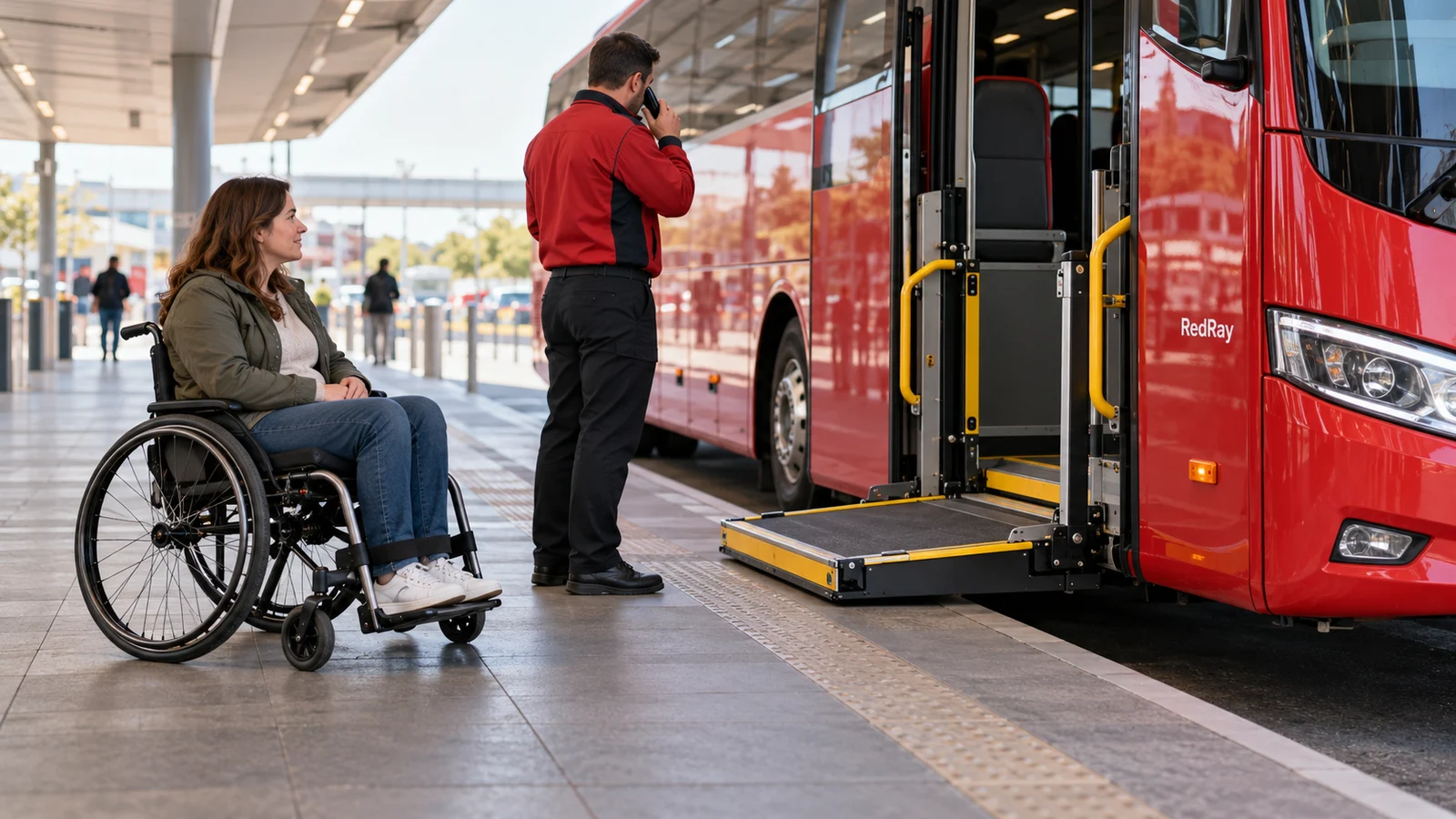
Separate the agreed need from the equipment’s condition
Show the crew available confirmation: the service and date assistance was agreed for, the exact action described and who responded. If the email says only “We will help”, clarify how responsible staff interpret that now. Do not require them to guess your needs from a diagnosis name or the wheelchair’s appearance.
Say briefly and functionally: “I need the agreed lift to board; I cannot manage these steps independently.” If needed, add mobility and wheelchair details necessary for compatibility checks. You do not need to announce your full medical history to the whole queue. Send sensitive details only to an appropriate recipient if genuinely necessary for particular assistance.
Do not determine the fault’s cause yourself. An initial enquiry only needs the observed fact: boarding using the agreed aid is not taking place. Ask responsible staff to explain whether this is a temporary procedural delay, inability to use it on this platform or unavailable equipment. That determines the next practical action, not passenger interference with equipment.
Arrange safe waiting pending a decision
With staff, identify a place away from traffic lanes that does not block doors or exits. Do not wheel onto unprepared equipment “just to try” or change someone else’s mechanism settings. If you need to move from your current place, ask for a permitted accessible route and the necessary assistance to be explained.
Keep documents, phone and essential belongings accessible. If a suitcase has already been put in the compartment, report that the boarding decision is unfinished and establish luggage arrangements. Avoid belongings leaving while you remain without a confirmed plan. Equally, do not open the compartment yourself or enter a manoeuvring area for a bag.
A companion can help with contact or explanations if you wish, but should not agree to an unexplained action on your behalf. Agree who speaks to the carrier and who stays nearby. If several people are responsible, ask for one coordinator: otherwise everyone may assume someone else has already given the final answer.
Ask for the alternative to be described before it happens
Instead of a general “We will get you on somehow”, you need an explanation of the permitted method offered, who organises it and whether it meets your needs. If you do not understand an action or cannot participate safely, say so before it begins. This article does not recommend manual-carrying techniques; these questions are not resolved by random internet advice.
Do not consider a replacement accessible merely because it has a spare seat. Check actual access to the passenger compartment, carriage of your wheelchair and the required positioning arrangements. If transfer to a bus seat is envisaged, this needs separate explanation and checking, not assumption on your behalf. Being able to manage one step does not describe the entire boarding process.
If another platform or vehicle is offered, check how to reach it, who will meet you and whether the required aid is already confirmed. Do not follow staff along an undefined route simply because “It should be easier there”. Ask them first to contact the responsible party at the new place. This reduces the risk of repeating the same problem far from the original support.
Check not only entry but the rest of the international route
Even successfully arranged boarding does not answer how required disembarkation at the border, transfers or final drop-off will happen. Clarify accessible arrangements for every unavoidable stage. Do not assume the passenger may remain on board throughout if the responsible parties have not confirmed this.
Establish whether crew or vehicles change and how information about agreed assistance will be handed over. A brief written action note is more useful than “The driver knows everything already”. Do not include unnecessary health details. Preserve the practical agreement: what is needed, at which stage and through whom changes are clarified.
If the new arrangement adds feeder transport, check that vehicle’s accessibility too. A large bus with appropriate boarding equipment does not automatically make the minibus taking you to it suitable. An intermediate station and final stop may also offer different access. Do not agree the whole chain based only on entering the first vehicle.
If there is no confirmed solution now
Ask to be connected to the carrier’s operational support or assistance coordinator. Provide the journey number, location, agreed need and actual obstacle. Ask which options have been checked and which are only being discussed. Do not call an offer final until transport, access, documentation and the next contact are clear.
If boarding did not happen, ask for the reason and available enquiry procedure to be explained. Retain advance-agreement confirmation, evidence of your presence at the point and responses received. You do not need to film other passengers or ask them to disclose medical details to support your case. What matters is an accurate timeline of the specific need and the response to it.
Do not confirm voluntary cancellation if you actually only want to clarify the consequences of failed boarding. Phrase the request precisely: “Boarding using the agreed aid did not take place; please explain the ticket’s status and available solutions.” If a future segment or return needs changing, identify it separately and check the effect on the remaining order.
Assistance rules do not replace checking the particular case
The official Your Europe portal describes assistance for bus passengers with disabilities or reduced mobility and exceptions linked to safety and design. Applicability of specific protections is checked against the transport’s parameters. Do not treat a service’s international nature alone as a sufficient answer about every right and procedure.
Operator conditions, such as FlixBus’s accessibility section, also contain their own checking procedure and restrictions. This is not a universal technical requirement for every wheelchair or another company’s bus. Ask for the basis of the decision for your service and, if you disagree, use the appropriate enquiry procedure rather than turning the platform into a technical experiment.
Alternative transport, a hotel or accompaniment you pay for independently do not automatically become approved expenses. If such action is necessary, retain an explanation of circumstances and proper documents, and check responsibility separately. Do not accept unclear refusal wording merely to end the conversation quickly; ask for a copy and an explanation of its contents.
Preparing another attempt to travel
For a new service, do not forward an old “Agreed” message without checking. Clarify the date, actual vehicle, required equipment and on-site staff contact. If the vehicle changes, check important conditions again. A technical explanation of the previous failure helps an enquiry, but does not itself confirm the next bus’s readiness.
Make a brief safe-waiting plan: permitted location, available contact channel, essential belongings with you and how to inform relatives. Do not add unnecessary diagnoses to the service’s general chat. A passenger should receive clear information and be able to ask questions, not prove willingness to accept unsafe boarding for the rest of the queue.
Questions and answers
Should other passengers help carry me into the bus?
Do not organise ad hoc carrying. Contact responsible staff and ask for a safe, proper assistance method to be explained. Agreeing to travel does not mean agreeing to any improvisation; this article provides no lifting techniques.
Another bus is offered. What should I check first?
Not just a spare seat, but access to the passenger compartment and carriage of your wheelchair. Then clarify required disembarkation, connections, documentation and a responsible contact. If an important condition remains uncertain, say so before agreeing.
Can a companion confirm the proposed method for me?
Help with communication should not replace your participation in the decision. Ask for the specific action to be explained to you accessibly. Do not agree an unexplained process merely because someone nearby is rushing to finish boarding.
How can I record the problem without filming everyone around me?
Keep the agreed need, service details, time and place, the staff member’s explanation and support responses. Record which action failed and what was offered instead. Other people’s passports, medical information or queue portraits are unnecessary.
Does an unavailable lift automatically mean all expenses are refunded?
That conclusion cannot be drawn without checking. You need facts, applicable rules and a decision on your enquiry. First establish ticket status and specific available alternatives, retaining extra-expense documents separately.
Official sources and preparation
Before travelling, useful reading includes a wheelchair on a bus and assistance when leaving the bus for checks. Check general information on Your Europe for passengers with reduced mobility, and your own conditions with your carrier. An example of separate operator rules is provided by FlixBus conditions. Sources checked on 23 October 2026.