

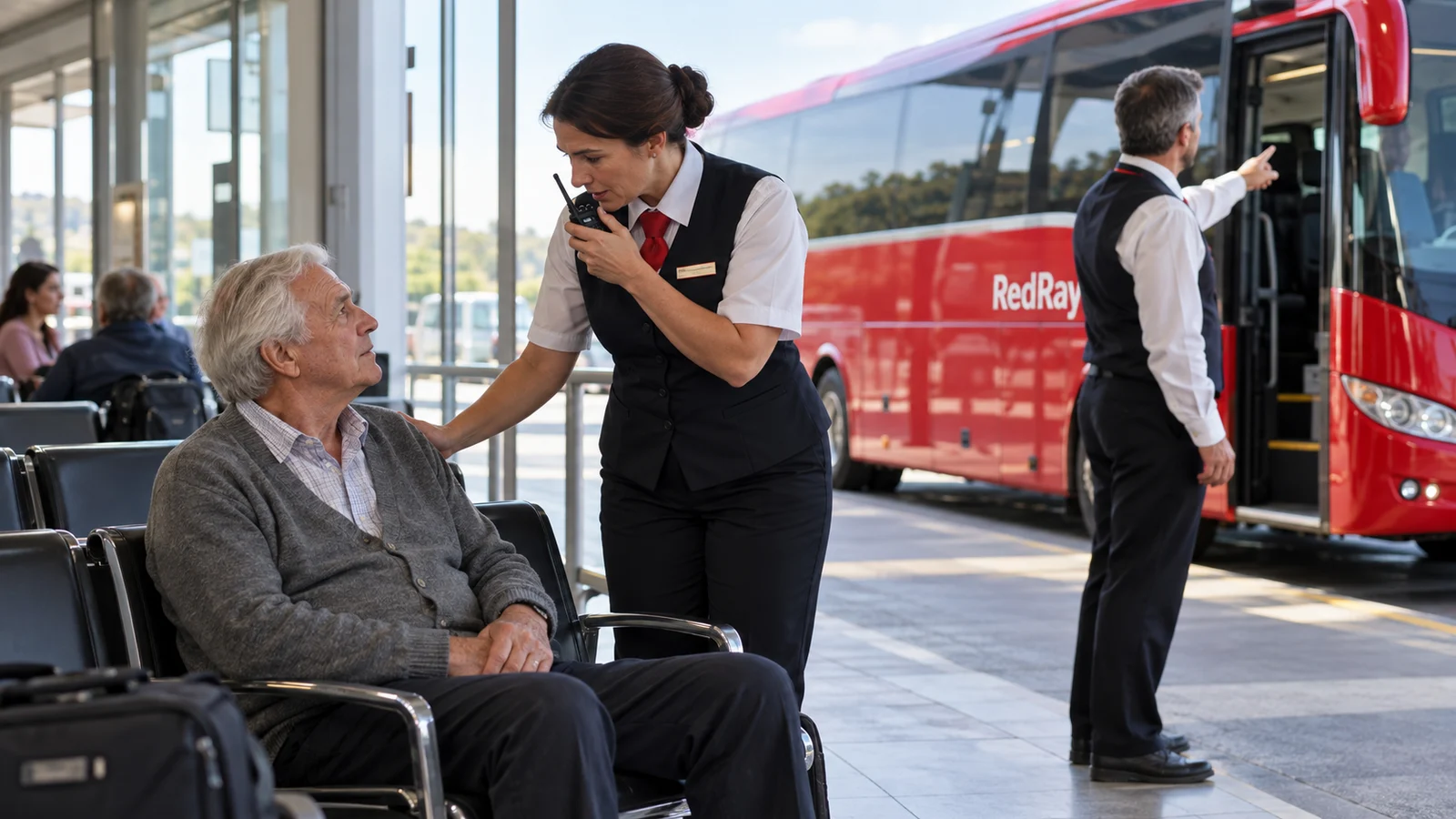
If a passenger becomes unwell during bus border checks, do not wait until returning to the coach to seek help. A checkpoint is a controlled area: searching randomly for an exit or trying to catch the bus yourself can complicate access for services. Alert a responsible employee and, in an emergency, contact emergency services. Then follow their instructions, not advice from a random chat.
This article explains reporting and coordination, not diagnosis or treatment. It does not decide whether someone can continue travelling, recommend medicines or promise free medical care. When immediate action is needed, ticket, insurance and luggage matters are addressed after calling for help, not instead of doing so.
Do not wait for every formality to finish
You do not first need to complete passport checks, find an insurance policy in a suitcase or receive a ticket seller’s reply. Report the problem now. Tell an official directly: “This passenger needs medical help. They are here, beside this location.” If you cannot approach, use your voice or an accessible method to attract attention and ask a specific person to notify an official.
Do not downplay known facts for fear of delaying others. Equally, do not invent a diagnosis from someone’s appearance. Report what you can reliably observe and describe, and answer the employee’s or dispatcher’s questions. A change in condition is important new information, not a reason to cancel an accepted call yourself.
Explain exactly where the person is
“We are at the border” or “near the red coach” may be insufficient. Give the checkpoint, country or side if known, direction of travel and the specific hall, sector or desk. If the bus is nearby, add its registration or a confirmed identifying feature. Do not guess the sector name: ask an employee to help identify the exact location.
The bus registration helps the crew, but emergency services need access to the person’s actual location. Several similar coaches may be far apart on a large site. Do not give coordinates for an earlier route stop simply because they are open on your phone. Check the current location with someone familiar with the area.
How to contact emergency services
In the European Union, 112 is available for genuine emergencies and the call itself is free. This does not promise free subsequent treatment. For other countries, check official emergency contacts along your route beforehand. Do not use an emergency line for questions about queue duration or bus compensation.
Official Polish advice for calling 112 emphasises the precise location, a brief description and answers to the operator’s questions. Also provide a contact on which you can be reached. Do not end the conversation before the operator confirms the necessary procedure. Remain available for a callback and report significant changes as instructed.
One clear contact instead of contradictory messages
If several adults are present, quickly establish who is already contacting the service and who will notify the crew. This must not delay the call. The person beside the passenger provides factual updates rather than simultaneously arguing in chat about departure. Do not silently assume “someone has called”: establish whether the report was actually accepted.
If a call has already been made, do not organise dozens of independent repeats giving different addresses. Tell others it has been accepted and who is maintaining contact. This does not prohibit calling again if circumstances change or the dispatcher instructs it. The aim is to remove confusion, not impose your own emergency-service procedure.
Do not find your own route through staff doors
Tell an official that help is needed inside the controlled area and ask for appropriate access to be organised. Do not send a companion randomly beyond a barrier to meet a vehicle. If services need someone to guide them, clarify who may go where. Responsible employees coordinate access and movement in the zone.
Do not move someone merely to bring them closer to the bus or clear the queue. Coordinate actions concerning their condition and movement with the dispatcher or medical professionals. Likewise, if you need help, do not leave the permitted place on your own. Explain your need and location so services do not have to search another sector.
What to tell the crew without oversharing
A short message may suffice: “The passenger travelling under this ticket remains in the control zone; medical help has been requested. Return time is unknown. This number is the contact for transport matters.” Use the verified service contact. If calls are prohibited at your location or there is no signal, ask an official for a permitted way to relay information.
The crew needs transport facts, not a complete medical history. Do not publish photographs of the person, medical records or incident video in the general group. Do not promise “we will be back in a few minutes” without confirmation. Whether onward travel is possible and how the service will operate are separate questions.
Documents must not delay help
If required documents are accessible, prepare your passport, insurance policy and information expressly requested by the responsible service. Do not hand the whole organiser to a stranger offering to “take it there faster”. If documents are being checked at another desk, tell an official: do not disappear without explanation or try to retrieve them from a staff area yourself.
Contact the insurer through its official channel when this does not obstruct an immediate emergency call. Do not wait for expense approval before calling in a dangerous situation. Clarify cover and required evidence from the actual policy terms. Do not assume any insurance policy automatically pays everything.
Coordinating a companion and luggage
After requesting help, establish which next steps are permitted for the companion. Do not assume they may automatically enter any room or leave control with the person. Tell the responsible service immediately about children or others needing accompaniment, so arrangements do not depend on passengers’ guesses.
For luggage, tell the crew the number of pieces, identifying features and location. Do not ask a stranger to quietly carry belongings through control or leave them beside an exit. If the bus journey is interrupted, agree retrieval and ticket status with the carrier. A medical situation does not provide a universal answer about waiting, refunds or a new seat.
A hypothetical coordination example
Two adults are undergoing checks in a hall while their bus has moved forward. One needs help, and the other does not know exactly where the coach is. Rather than running between zones, the companion alerts the nearest responsible employee, gives the person’s precise location and arranges a request for help. Only then do they tell the crew the passenger cannot yet return, without predicting completion.
If needed belongings remain onboard, the companion describes them to the employee and crew and asks about the available procedure. They do not move the person to the bus for a bag. This example illustrates task allocation, not a medical protocol: actual actions depend on official and medical instructions, the person’s condition and local circumstances.
Return to travel planning after assistance
Once the urgent issue is addressed, establish whether onward travel is possible and what restrictions apply. Do not buy another bus ticket solely for fear of losing the original booking before knowing where and when the person can travel at all. Save the factual notification to the carrier and its reply without publishing medical details.
For advance planning, there are articles about seeking medical assistance abroad and notifying individual needs. They do not replace calling in a dangerous situation. If someone has not returned and their location is unknown, follow the separate reporting approach for a missing companion after control.
Official contacts and the article’s scope
Checked on 23 October 2026: the European Commission on 112 and official Polish advice on reporting an incident. At a border, follow responsible services’ instructions on access and current location. This article does not determine treatment costs, diagnosis or fitness for bus travel.
Questions and answers
Should I finish the passport check first or report the need for help?
If health is at risk, do not delay seeking help to complete formalities. Tell a responsible employee about the need and the person’s location, contact emergency services if necessary and follow the instructions received.
I do not know the hall’s name: what should I tell the dispatcher?
Give the known checkpoint, direction and visible landmark, and ask an employee to clarify location and access. Do not invent a sector or provide an earlier stop’s address instead of your current location.
Does a free 112 call mean free treatment?
No. A free call does not determine payment for every subsequent service. Clarify those conditions separately; this must not delay necessary emergency contact.
Can I retrieve things myself from the bus beyond the barrier?
Clarify permitted access with a responsible employee and transport arrangements with the crew. Do not take staff routes at random or leave the person without necessary coordination for the sake of a suitcase.
Should I promise the crew a return time?
Report only known facts: help has been called, where you are and how to maintain contact. If completion is unknown, say so directly. Do not put the bus timetable above medical instructions.