

You have prepared your passport and a small bag, but staff explain that you must get off with all your own luggage. People with suitcases are already moving beside the bus, your carry-on bag remains above the seat and your large case is behind several similar ones. The priority now is to understand the exact instruction and keep your own set together through every permitted action, not simply remove the first item you can reach.
Unloading everything is not an identical mandatory procedure at every bus crossing. This article concerns a situation where responsible staff have already given that instruction. It does not determine customs restrictions for your contents or suggest a way to avoid inspection. Moving, presenting and returning belongings must be coordinated on site.
First clarify exactly what to take
Do not turn “all luggage” into your own list of exceptions. If you are unsure whether it includes a carry-on bag, separate case or bag in the passenger compartment, ask. Identify the specific item rather than arguing generally that it is “almost empty”. Equally, do not start carrying someone else’s belongings because your neighbour has already left: ownership and assistance arrangements must be clear.
Ask exactly where to go with your belongings and where to wait for the next action. A visible door or table is not necessarily intended for your group. Do not choose a shorter path between buses unless it has been confirmed as permitted. Listen carefully to the difference between preparing your set, taking it to a specific place and opening it for inspection.
If the crew relays information and part of the instruction concerns inspection, clarify it with the responsible official in a permitted way if necessary. Bus staff help organise unloading, but should not be the source of an invented decision about your belongings. If language is difficult, ask for the necessary step to be explained rather than agreeing blindly because others have already moved.
Assemble your set before joining the flow
Before leaving your seat, organise your carry-on belongings into one manageable system: document folder, phone, bag and any separate item you have. Do not put your passport on the seat to pull a suitcase with both hands. If required originals have already been handed to an official, remember that handover and follow the explained procedure; do not try to replace it with a random copy.
Count your own pieces of luggage. A suitcase, carry-on bag and separate case, for example, are not one general “pile”. The count helps reveal an omission, but does not prove ownership of every item. Check your own markings, material, handles and other familiar features. Do not remove someone else’s tag from a similar case because it conflicts with your assumption.
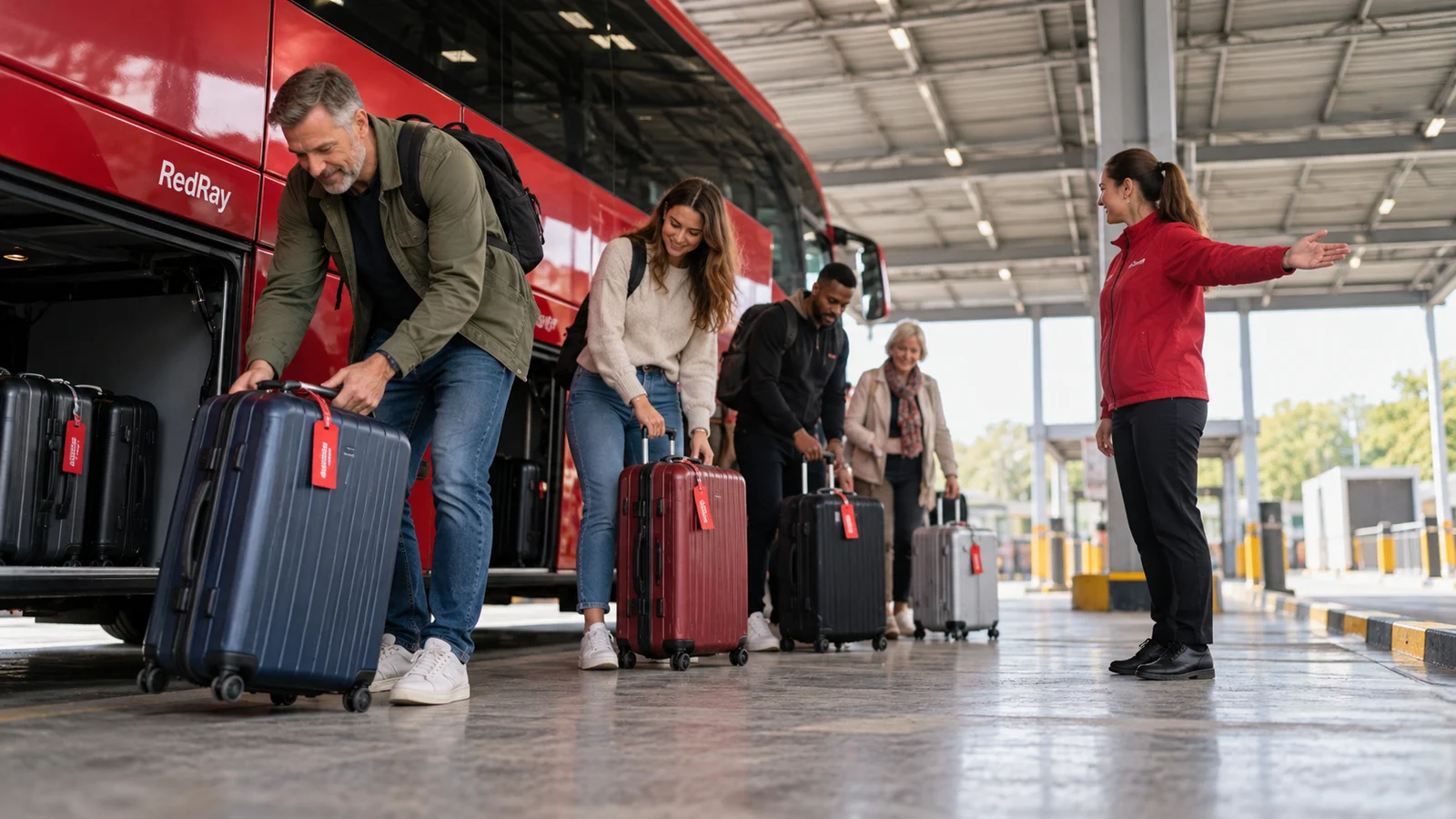
Approach the luggage compartment according to the crew’s procedure. Do not open other compartments or sort through belongings inside without agreed access. If your suitcase is behind others, tell the responsible person. Trying to clear a path quickly yourself can mix sets up before inspection and complicate returning belongings to other people.
Agree assistance before carrying things
If you cannot safely move the whole set, explain the practical need before joining the flow. For example: “I can carry my hand luggage, but cannot wheel two suitcases at once.” Clarify available assistance and the permitted sequence. Do not leave part of your luggage unattended intending to come back for it until you understand whether that movement is allowed.
A companion can help under agreed arrangements, but help with carrying does not change ownership of the contents or mean they must answer on your behalf. Do not give an unknown parcel to a random person simply because they have a free hand. If an officer needs to establish who owns an item, answer truthfully rather than creating a more convenient account on the spot.
Adults in a family can share carrying and child-supervision duties without blocking passage or leaving someone alone. Both must understand who controls each item and where waiting is permitted. Do not make a child responsible for the whole set or other people’s documents simply to move large suitcases faster.
Keep track of your own set during inspection
Present belongings and explain contents in response to the responsible service’s actual request. If an item inside a suitcase is required, clarify the permitted opening procedure and retrieve your own item, not a similar one from a neighbouring bag. Do not begin spreading everything around unnecessarily. The more packages open at once, the harder it is to track what returns to which set.
On the Ukrainian side, official State Customs Service information provides for presenting goods at a customs officer’s request and supplying necessary information. This does not mean an identical document set for every item. If supporting material is in your luggage, explain exactly where. Separate preparation of such materials is covered in the article on documents for an item in your suitcase.
If an item or bag is still being checked, do not treat it as returned just because you have been asked to step aside. Ask about the next action concerning your set. Equally, do not call every instance of an item being near a control point a seizure. Understanding the situation requires precise words from the responsible service, not a neighbour’s comment after seeing only part of events.
Repacking starts with checking, not rushing
When permitted to gather your belongings, return small items to their own compartments and close the packaging so it can withstand normal carrying. Do not force a fastener over badly arranged contents just because the queue is moving. If you need a short pause, explain why. Do not leave an open case in the permitted passage, forcing others to step over it.
Compare the count and recognisable features of every piece again. The phone in your hand and folder under your arm are also part of what you control, not items to put temporarily on any table. A private list prepared beforehand may help your memory. Do not photograph the control area, official materials or other people to create new proof of packing.
In this scenario, the important task is completing movement of the set, not creating a detailed photo archive. Do not delay returning with your belongings to photograph every suitcase. If you need to organise earlier records, there is a separate article on a photo inventory before a bus border crossing. Here, it is enough to know what has already been returned to you and what still needs clarification.
Reloading must also be coordinated
Do not walk to the bus merely because your case is closed. Check whether you may move now, exactly where to go and who is organising luggage acceptance. The bus may have changed parking position, so first establish the current location. Returning to the old door from memory does not replace the permitted route between the inspection point and vehicle.
When handing items to the crew, identify your belongings and make sure you have handed over the whole set under the service’s actual procedure. Do not count an item still standing nearby as loaded. If the carrier provides confirmation of acceptance, retain it. Do not invent a universal new tag after every inspection: establish the tracking method for the particular journey.
After returning to the passenger compartment, check that documents and your carry-on bag are accessible. Large suitcases may already be inaccessible until the next permitted stop. If something you need mistakenly went back into the compartment, report it immediately rather than trying to open it yourself. An instruction to continue moving does not make a practical error disappear, but its correction must be coordinated.
If the set does not match
Stop your own handover and report the exact fact: a missing case, an extra similar suitcase or uncertainty about a particular item. State its last confirmed location rather than speculating about who is to blame. Do not pass the problem to the next passenger saying “It is probably theirs.” The search needs a responsible party who understands the current inspection and loading procedure.
If the item cannot be found immediately, clarify who accepted your report, how to receive a response and what to do next with your own set. Do not leave the permitted place to return to the inspection table independently. Keep the necessary private timeline without other people’s passports or official lists. It helps explain the event, but does not itself guarantee recovery or reimbursement.
Questions and answers
Is all luggage necessarily unloaded at every bus crossing?
No. This article does not establish such a universal procedure. Follow responsible staff’s actual instructions and clarify an unclear scope before carrying belongings.
Can I take a companion’s suitcase if they have already gone into the hall?
First agree the assistance and movement procedure. Do not take an unclear set belonging to someone else at random or present its contents as your own. Help with carrying does not replace the owner’s proper explanations.
Can a suitcase closed after inspection go straight back to the bus?
Clarify whether the required action is complete and further movement is permitted. A closed lock does not confirm that you may leave the control point or start loading independently.
Which matters more before loading: the count or the bags’ appearance?
Both. The correct count does not rule out a swap of similar belongings. Check ownership of each item and report any mismatch immediately before handing over the set.
Official basis
See State Customs Service information for individuals and Ukraine’s procedure for establishing security arrangements at border crossings. Sources checked on 23 October 2026. Clarify another country’s requirements and actual inspection arrangements with its competent service; this article does not change import rules for items or guarantee the procedure’s duration.