

A small ceramic item, musical instrument or sensitive work device may need more attention than ordinary hand luggage. Its owner wants to keep it nearby, but there is no automatic right to place it on an empty seat or in the aisle. Before purchasing, establish whether the carrier accepts that particular item and which placement is permitted.
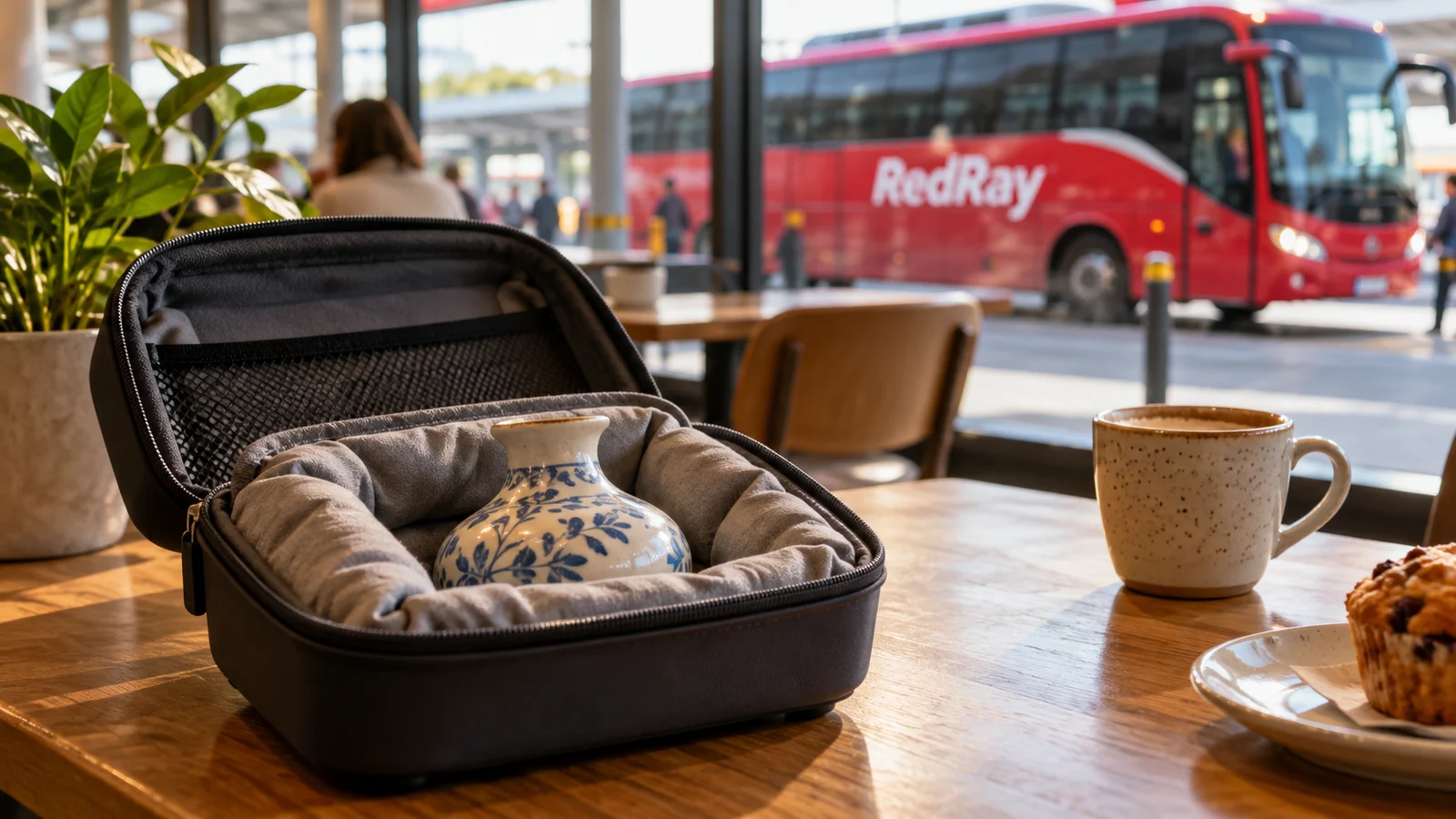
We do not repeat general souvenir-packing advice here. The main issue is approval for a specific item in the cabin and what to do if it is refused at boarding. Good packaging matters, but does not replace checking size, characteristics and the bus’s actual capabilities.
Describe the item precisely enough for a specific answer
Tell the carrier what the item is, its dimensions in protective packaging, weight and any characteristics affecting carriage. “I have something fragile” is insufficient. It matters whether it is a small case, a long rigid case or a box that cannot be tilted. Do not understate dimensions hoping to negotiate on arrival.
If it contains a battery, liquid, sharp components or another special feature, mention it separately and check applicable restrictions. Do not call it simply a souvenir if it contains equipment subject to additional requirements. Low weight does not mean every characteristic is equally acceptable in the cabin or hold.
If needed, add a photograph of the closed packaging and a rough dimension diagram. Do not send expensive invoices or personal documents to an open chat. Initial approval requires actual specifications and handling conditions. If proof of value is needed for a particular operation, submit it only through a proper private channel.
Ask for more than a simple “yes”
Establish whether the item is accepted specifically in the cabin, where it may be placed and whether separate booking is required. “We carry luggage” does not approve carriage beside a seat. If staff describe only the general hand-luggage allowance, ask whether it covers your case with the specifications provided.
Ask whether approval must be reconfirmed for the particular date and service. Advice received months earlier about another vehicle is not a reliable basis for a new journey. Keep conditions with your documents so that you can show the agreement’s content at boarding instead of recounting it from memory.
If you are offered an additional passenger seat, clarify separately whether it may be used for the item and how that must be properly booked. Buying a second ticket yourself does not resolve all placement issues. The item must be accepted under the carrier’s procedures, not simply placed on a seat because you paid for it.
Packaging must suit the agreed method
Provide protection against impacts, rubbing and movement inside the container. Check fastenings, the handle and whether the case can be carried without opening accidentally. Do not expect passengers continually to step around an item you carefully hold with your foot. Safe placement must not depend on their constant attention to your property.
Do not add packaging after approval that substantially changes the outside dimensions. If protection requires a larger box, submit the specifications again. Do not argue at boarding that “the item itself is small” when its actual container no longer matches the description. Placement depends on the item as ready for carriage.
Allow for proper inspection of the item if required. Do not use packaging to conceal contents or avoid questions. For international travel, separately establish rules for moving that item through the countries on your route. Bus approval concerns carriage arrangements and does not replace government requirements.
What to do when boarding
Show the item and saved confirmation before entering the cabin with it. Ask the responsible staff member to identify the agreed location. Do not put a case on someone else’s seat, in the aisle or beside doors assuming “it will be moved later”. Once boarding begins, it becomes harder for others to pass and for you to clarify matters calmly.
If the actual bus differs from the expected vehicle, ask for available options to be assessed again. Do not demand placement in a location that does not exist on this bus. Equally, show exactly what was agreed and establish how the replacement affects the purchase. Physical feasibility and a booked service are related but different questions.
Do not treat another passenger’s verbal offer to hold the item as a proper solution without crew approval. They may change their mind, leave earlier or lack a safe location. Your agreement with them does not change cabin rules. Likewise, do not leave the item with unrelated staff without a clear handover and collection method.
If cabin carriage is refused, clarify why
The reason may concern dimensions, characteristics, packaging or lack of a permissible space. Ask for it to be specified. This determines whether repacking makes sense, another departure should be checked or another delivery method is needed altogether. Do not change several things at random without understanding what prevents acceptance.
If the hold is offered, assess whether the packaging suits that method and ask about acceptance conditions. Do not automatically agree under time pressure if the item was prepared exclusively for different handling. Equally, do not assume that “fragile” obliges the carrier to provide an individually protected space.
If repacking is suggested, ask whether the new version will be acceptable and where it can be done safely. Do not remove necessary protection just to make the container fit. Do not leave rubbish, sharp components or an exposed item in a passageway. Tell staff if a solution requires time rather than silently delaying departure with work beside the door.
Prepare to carry the item off at the terminus as carefully as you prepared for boarding. Do not pass an open case through people in the aisle. Wait for a safe moment and ensure you take detachable handles, protective parts and your own documents that may have been kept separately.
How to record an agreement that was not fulfilled
Keep the original specifications, carrier’s reply, purchase documents and actual boarding explanation. Distinguish a promise to accept the item from general advice. If a separate service was booked, establish its status and available complaint procedure. Do not treat all subsequent expenses as automatically reimbursable merely because correspondence exists.
If you choose not to travel, clarify how that decision affects the passenger ticket and additional service separately. If you travel without the item, arrange proper storage or handover. Do not leave an expensive object with a random person promising to send it through another driver. You need a clear method you can verify and track through documentation.
Describe facts without exaggeration in your complaint: what you reported, the reply received, the container you brought and the boarding explanation. Do not photograph others’ documents or internal lists. A photograph of your own packaged item and an accurate timeline are more useful for checking than allegations unsupported by established circumstances.
Questions and answers
Can a small fragile item automatically go in the cabin?
No. Check its characteristics, packaging’s outside dimensions and the particular carrier’s procedures. Small size alone does not determine permissible placement.
Is writing “fragile” on the box enough?
That label does not replace proper packaging or agreement on the carriage method. Check whether the container suits the location actually permitted.
If I buy a second seat, can the item go on it?
First agree that this is permitted, how the item will be placed and how to book it. An ordinary second passenger ticket is not universal permission to use the seat for an object.
What should I keep if an approved item is refused?
The original specifications, reply, ticket and additional-service details, plus the specific boarding explanation. The complaint outcome depends on circumstances and purchase conditions.
Useful links
Find other luggage articles in the RedRay blog, and check your particular journey’s conditions through contacts on the RedRay website. This article does not set luggage allowances for every carrier or guarantee protection of any item regardless of packaging.