

An international bus journey passes unusual buildings, queues of vehicles and border signs. You want a photo as a memory or to show people close to you where you are. However, being able to photograph an ordinary tourist street does not mean the same arrangements apply at a checkpoint. Before taking pictures, understand the restrictions of the particular place and the responsible authority’s instructions.
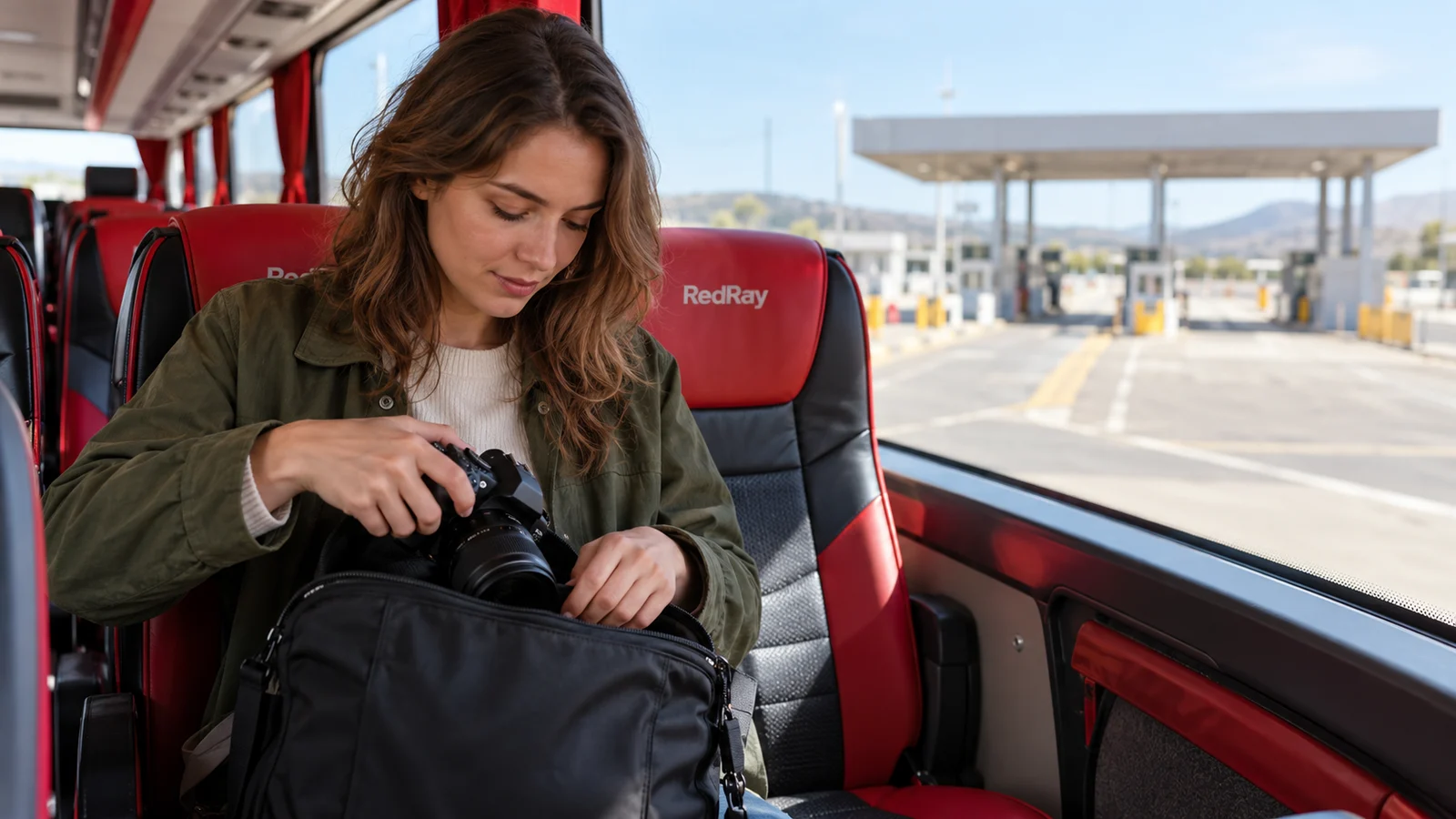
This article makes no universal claim that photography is always allowed or always prohibited near every border. Countries, areas and operating arrangements differ, and temporary conditions may apply. The practical aim is simple: do not turn a wish to take a photo into a conflict with procedures, unsafe movement or sharing other people’s documents.
Distinguish a tourist route from a control area
A general city view before travelling, a bus cabin and a checking area are not equivalent places. Each may have its own photography and access arrangements. Do not apply permission received in a café along the way to an official hall. Likewise, a crew instruction about cabin arrangements does not replace a government authority’s explanation about a control facility.
Notice visible signs and announcements, but do not treat the absence of a familiar symbol as automatic permission. If you do not understand the area’s boundaries or the announcement’s language, ask an employee before starting to record. Be specific: may you take photographs from this particular permitted place, and what must not appear in the frame?
Do not leave the bus solely for a better angle if that movement has not been agreed. Do not go around barriers, traffic lanes or staff doors. Even a neutral photo can be obtained unsafely. Photography is not a reason to ignore the locally established arrangements for boarding, stopping or pedestrian movement.
Ask before starting, not after a warning
If in doubt, a short clarification reduces ambiguity. There is no need to take out a camera and start livestreaming, then argue that the picture was “only for myself”. The authority can explain photography boundaries or ask you not to use a device in a certain place. Follow the instruction and calmly clarify any unclear part.
Your question should concern the actual action. Permission to take one neutral picture should not be interpreted as permission to photograph official screens, employees’ faces or record continuously. If your intention changes, clarify the procedure again. Do not independently expand a brief answer to cover every possible form of photography and publication.
Do not rely on a fellow traveller saying “I always take photos here”. Their experience may concern another area, another time or have had no approval at all. The useful source for a particular place is the competent authority and current official instructions. Another passenger’s personal confidence does not transfer responsibility for your actions to them.
Check the background as well as the main subject
A photo of your own suitcase may accidentally include someone else’s open passport, a checking screen or a list of surnames on a table. Glass reflections sometimes reveal more than the direct view. If photography is permitted, first inspect the composition and put away your own unnecessary documents. Do not approach other people’s materials to obtain a sharper image.
On a group trip, ask for the consent of people you want to show in a private album or post. With other people’s children and personal documents, it is particularly important not to make public photography a routine action without agreement. Someone may not want a wide audience to know about their journey, even if you boarded the bus together.
Do not photograph another person giving answers during checks as an “interesting travel moment”. You do not know what private information the conversation contains or which restrictions apply there. A neutral scene outside the procedure, where creating it is permitted, is enough for your own memory. A journey does not require a documentary record of every check.
A phone is also a camera
Do not assume restrictions concern only a large camera. A smartphone can record video, livestream or take pictures automatically. If using it for a ticket or message, do not secretly record the procedure in the background. Distinguish the device’s intended purpose from the actual action you perform.
Check in advance whether recording can start accidentally through a shortcut button or setting. Before entering an area where device use is restricted, close unnecessary apps and put the camera away. Do not give your phone to a companion and ask them to record instead if you have already been instructed not to.
Permission to open a document on a screen does not automatically permit photographing the surroundings. Show what is required and follow the employee’s instruction about further use. Do not argue based on the device’s appearance: what matters is not whether it looks like a tourist camera, but what exactly you are doing and where.
How to update people close to you without photos of checks
A short text often explains the situation better: the bus is waiting, the procedure is ongoing or movement has resumed. Write only when phone use is permitted and safe. Do not promise an exact completion time you have not been given. A queue photo without a date and explanation can instead create unnecessary anxious assumptions.
Agree update milestones before departure. For example, you will write after receiving new confirmation from the carrier or completing the relevant stage. If there is no contact for a while, people close to you will already know this is possible. Such arrangements reduce the need to prove your location with a picture from a control area.
For a wider audience, you can prepare an account after the journey using your own permitted neutral photographs. You do not have to publish your exact current location and route in real time. A personal travel diary can be interesting without official facilities, other people’s faces or your ticket details.
If an employee issues a warning
Stop the action concerned and calmly clarify the required procedure. Do not continue recording secretly, livestream the argument or ask a companion to record it covertly. If you do not understand the requirement, ask for an explanation you can understand. Do not invent universal legal arguments on the spot for every country and area.
If questions arise about material already created or further actions involving the device, clarify them through the appropriate official procedure. Do not conceal circumstances or try to “cover your tracks” yourself and then argue for a different account of events. If a subsequent enquiry is needed, keep your own accurate chronology without circulating sensitive images again.
Do not conclude that any warning automatically means equipment confiscation, a fine or refusal of travel. Consequences depend on specific rules and circumstances that this general article does not establish. Avoid both unfounded panic and certainty that “nothing can happen”. Ask for a competent explanation of your own situation.
How to prepare a safe photography plan
- Photograph travel scenes where the arrangements are clear and photography is permitted.
- Do not include other people’s documents, screens, private conversations or operational details.
- Do not change your permitted route or step into the road for a better angle.
- Use text for journey updates when a photo creates unnecessary questions.
Separate equipment being transported from equipment being used in advance. A properly packed camera can simply remain in your bag during procedures. Having a camera does not oblige you to use every minute of travel for photography. Take it out later in an appropriate place when doing so will not interfere with checks or other passengers.
If travelling as a blogger, do not regard that role itself as special permission. Planned professional work may have separate requirements that you should check beforehand with the competent party. Do not treat an ordinary passenger journey as grounds for any type of filming without clarifying the procedure.
Review material before publishing
Even a permitted photograph deserves an enlarged review. Is another person’s ticket, document number, signature or private message in the background? Does the caption suggest the image shows the checkpoint operating today when it was taken earlier? Publication should explain origin and context rather than add a false impression of live reporting.
Do not use your own photograph as universal proof of the rules. Taking a picture once without a warning does not mean permission for every future passenger. When advising others, it is better to explicitly suggest checking current arrangements at the particular location. One personal journey does not cover different borders and possible temporary conditions.
If unsure whether a problematic picture is needed at all, choose another illustration. Your story could use a suitcase before departure, a permitted general city view after arrival or a travel notebook. Forgoing one photograph does not take away your travel memories, but it may preserve a calm process for you and those around you.
Questions and answers
Is photography always prohibited near a border?
This article provides no universal rule for every country and area. Check the particular location, current restrictions and competent authority’s instructions before taking pictures.
If there is no crossed-out-camera sign, is photography definitely allowed?
Do not draw that conclusion solely from the absence of a familiar symbol. If uncertain, ask a responsible employee which actions are permitted exactly where you are.
Can I secretly record on a phone instead of a camera?
Do not use another device or hidden mode to bypass an instruction received. A phone can also record; the same attention to the actual action and respect for local arrangements are needed.
How can I tell my family I am still undergoing checks without a photograph?
Send a short truthful text at a permitted moment. Agree in advance that contact may pause and which next milestone will prompt an update, without promising an unknown completion minute.
Official sources and enquiries
For the Ukrainian section, start checking with the official State Border Guard Service of Ukraine website and citizens’ enquiries section. For another country, contact its competent authority. Sources reviewed on 21 October 2026; this general article does not determine specific photography rules or legal consequences.