

You board with a bag you considered small, but it will not fit on the shelf or protrudes above the seat. Putting it in the aisle seems easiest, particularly with passengers waiting behind you. However, resolve the problem with the crew so belongings do not obstruct people or remain insecurely placed.
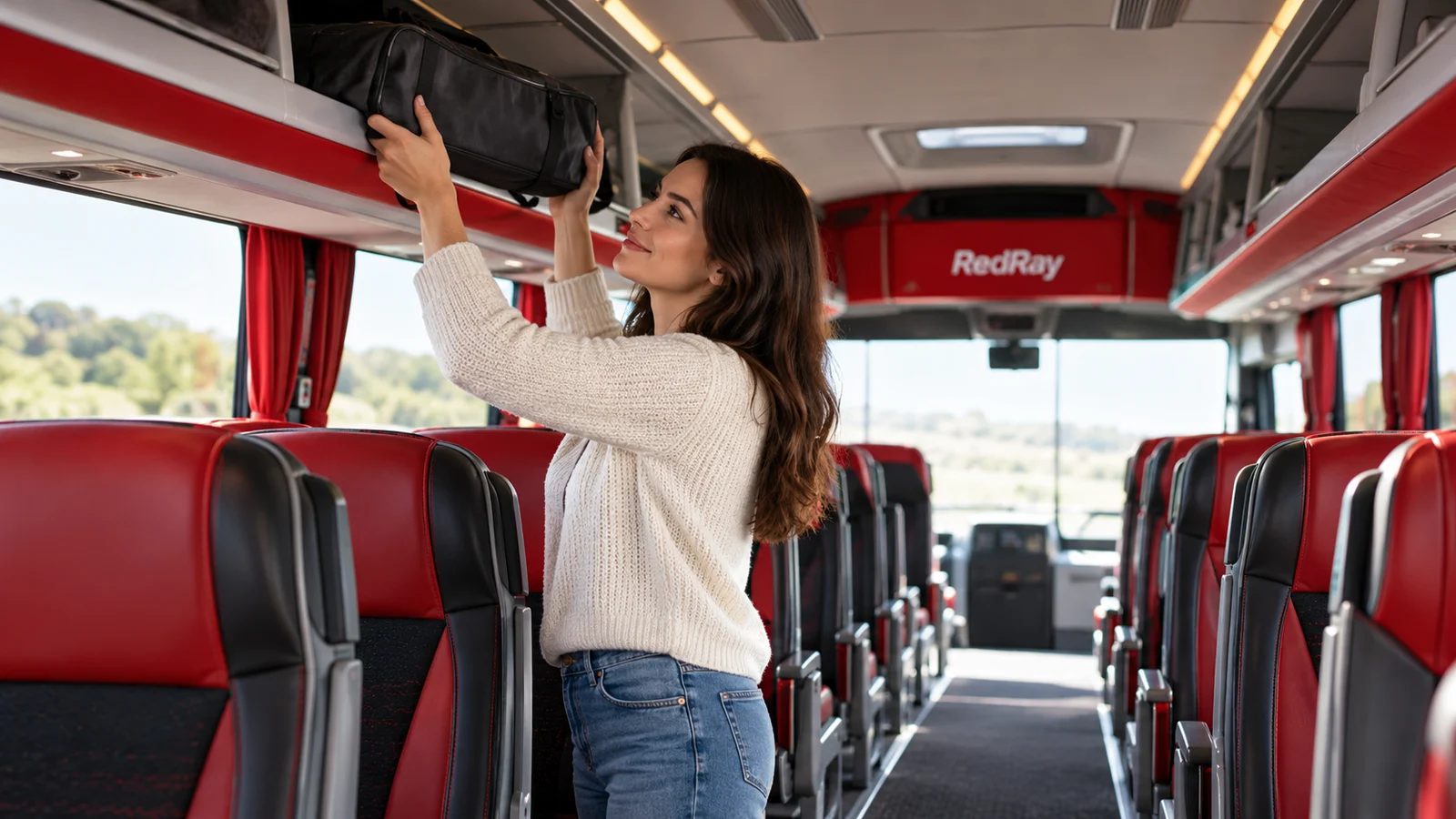
Actual shelf capacity depends on the bus. A cabin image from another service or experience from a previous journey does not guarantee your bag fits here. Below is a procedure for the situation already encountered, without assumptions about universal dimensions, equipment or every carrier’s rules.
Do not force the bag in at any cost
If an item is too high or wide, do not push against the shelf or use neighbouring luggage as support. Do not leave part of the bag hanging over a passenger. Lack of space does not make unstable placement acceptable. Briefly tell the crew rather than hoping “the road will be smooth”.
Do not stand on a seat or ask a companion to hold a heavy bag above people’s heads as the bus starts moving. If boarding continues, move to an agreed safe place without blocking the doors. Let others pass while remaining available to resolve the issue, rather than hiding the item in the first empty recess.
Do not leave the bag in the aisle promising to remove it later. After departure, people’s movement, lighting and opportunities to repack may differ. Clarify an acceptable option beforehand. It is especially important not to block doors or obstruct people who use mobility assistance.
Clarify what is allowed in the actual cabin
Tell a responsible employee the bag does not fit on the shelf and ask where it may go. Do not call an arbitrary recess a “luggage space” without confirmation. Space under a seat, near a partition or beside stairs may serve different purposes. Consider the specific design and service arrangements.
If offered space under a seat, check the bag actually fits without obstructing feet, the aisle or seat use. Do not alter mechanisms or detach bus components to create more space. The item must not prevent normal sitting or use of the provided safety equipment.
Do not put a heavy bag on an empty adjacent seat without agreement. A passenger may need it at the next stop, and the item itself may remain insecure. Even if you paid for an additional seat, clarify separately how it may be used for belongings. Payment does not automatically determine an acceptable securing method.
Separate what you need during travel from the remaining luggage
If putting the bag in the hold is permitted, first remove your documents, money, means of communication and items needed during the journey. Also check items subject to separate carrier requirements or transport rules. Do not assume any contents are suitable for the hold merely because the bag was called hand luggage.
A small internal organiser that can be removed without complete repacking is convenient. Do this before the hold closes and in a safe place. Do not spread belongings on a vehicle route, near wheels or in front of open doors. If time is short, say you need a brief content check rather than handing over everything at random.
Do not leave your only access to the ticket or contacts in the bag if you cannot retrieve it until arrival. Your paper document, phone and necessary confirmations should remain accessible for your journey. Equally, do not put so many things in the small bag that the same placement problem recurs.
Will repacking help?
An outside pocket, rigid case or disorganised contents sometimes add bulk. If safe repacking is possible and agreed, check the result before placement. Do not conceal the problem by tightly pulling a zip that no longer closes. The item must remain suitable for normal use.
Do not remove protective packaging from fragile or valuable equipment merely to fit it on the shelf. Repacking should not create a new risk to the contents. If the item cannot be placed with proper protection, another agreed solution is needed. This may depend on the item, bus and your booking conditions.
Do not distribute contents into other people’s bags without consent and understanding of who carries what. Such confusion is particularly undesirable internationally. Everyone should control their own belongings and avoid accepting an unknown item merely to reduce another person’s luggage volume. Boarding convenience does not justify concealing actual contents.
If the bag contains an item needing attention
Explain the necessary condition without excessive personal disclosure. For example, you need access to a particular personal item during the journey. Do not use this to demand unsafe placement. Ask for an acceptable option or clarification of whether carriage is possible under the service’s actual conditions.
Do not assume the driver can guarantee a particular temperature, humidity or preservation of any contents in an arbitrary location. If an item has special requirements, check them beforehand with a competent source and the carrier. On boarding day, state the actual need directly rather than relying on “the bag is delicate”.
If there is no safe permitted solution, discuss options before departure. Do not leave an item with someone known only through a chat without clear handover, or hide it from the crew. If your travel plan needs changing, separately clarify the ticket and additional-service status: a shelf problem alone does not establish refund conditions.
Check the result after placement
Sit normally and make sure you can use the seat without awkwardly shifting your body because of the bag. Check straps and handles do not obstruct your neighbour or the aisle. If the item went in the hold, understand how it will be identified on arrival and which confirmations to keep under the carrier’s procedure.
Do not forget items temporarily removed while repacking. A ticket on a table, a case on the next seat and a charger in a pocket are typical things missed after rushing. Before departure, gather your small set and make sure every item has a clear location rather than lying “for a minute” in a shared area.
If you notice the bag has shifted or is obstructing something during travel, notify the crew safely. Do not lift heavy items over people’s heads while the bus moves or changes speed suddenly. Wait for an agreed safe moment to correct it. Trying to remove the problem quickly must not create danger for others.
How to avoid a repeat on the next service
Before buying, check the hand-luggage allowance for the chosen carrier and service. Consider not only external dimensions but also rigid shape and filled pockets. A soft bag may seem compact when empty and become completely different when packed. Measure and assess the actual packed item, not its advertising description.
Do not draw conclusions from a photograph of another vehicle. Clarify important needs before payment if travel is impossible without a particular placement method. Keep the reply, but remember to check again if the bus changes. Agreed luggage and the actual capacity of a particular cabin need comparison, not treatment as a single fact.
Plan your carry-on bag around access to necessary items rather than wanting all your possessions nearby. A separate small organiser reduces repacking and helps prepare for a stop faster. Still check the permitted number and type of items: small size does not remove other transport rules.
Questions and answers
If the bag does not fit, can I leave it in the aisle?
Do not use the aisle or doorway as an unauthorised luggage space. Tell the crew and agree permitted placement that does not obstruct passengers or cabin use.
Is under-seat space always suitable for any bag?
No. Check the actual design, item size and particular bus’s arrangements. Do not position a bag where it obstructs feet, the aisle or mechanisms.
What should I remove before putting the bag in the hold?
Documents, communication devices and your own essentials for the journey; also check requirements for the remaining contents. Do not automatically hand over everything without understanding item transport conditions.
Does a cabin photograph guarantee my hand luggage will fit?
No. The photo may show another vehicle, and the actual bus’s capacity needs separate assessment. Clarify important needs and the bag’s real measurements before travelling.
Useful links
Find your service’s conditions and verified contacts on the RedRay website. Practical luggage advice is available in the RedRay blog. This article does not set universal shelf dimensions or promise identical equipment on every bus.