

You can see your bus at the platform and the ticket’s departure time has not arrived, but the doors are closed and a staff member says boarding has finished. The worst response now is to argue your case while standing in front of the vehicle or try to open the doors. First establish exactly which rule was applied to your service and whether there is a safe, permitted way to continue travelling.
The bus’s physical presence does not show the status of passenger check-in. The vehicle may still be waiting for permission to leave or completing final tasks while passenger acceptance has already ended. Equally, “Boarding is closed” does not itself explain every circumstance. The purchase conditions, your actual arrival time at the correct platform and an authorised staff member’s response matter.
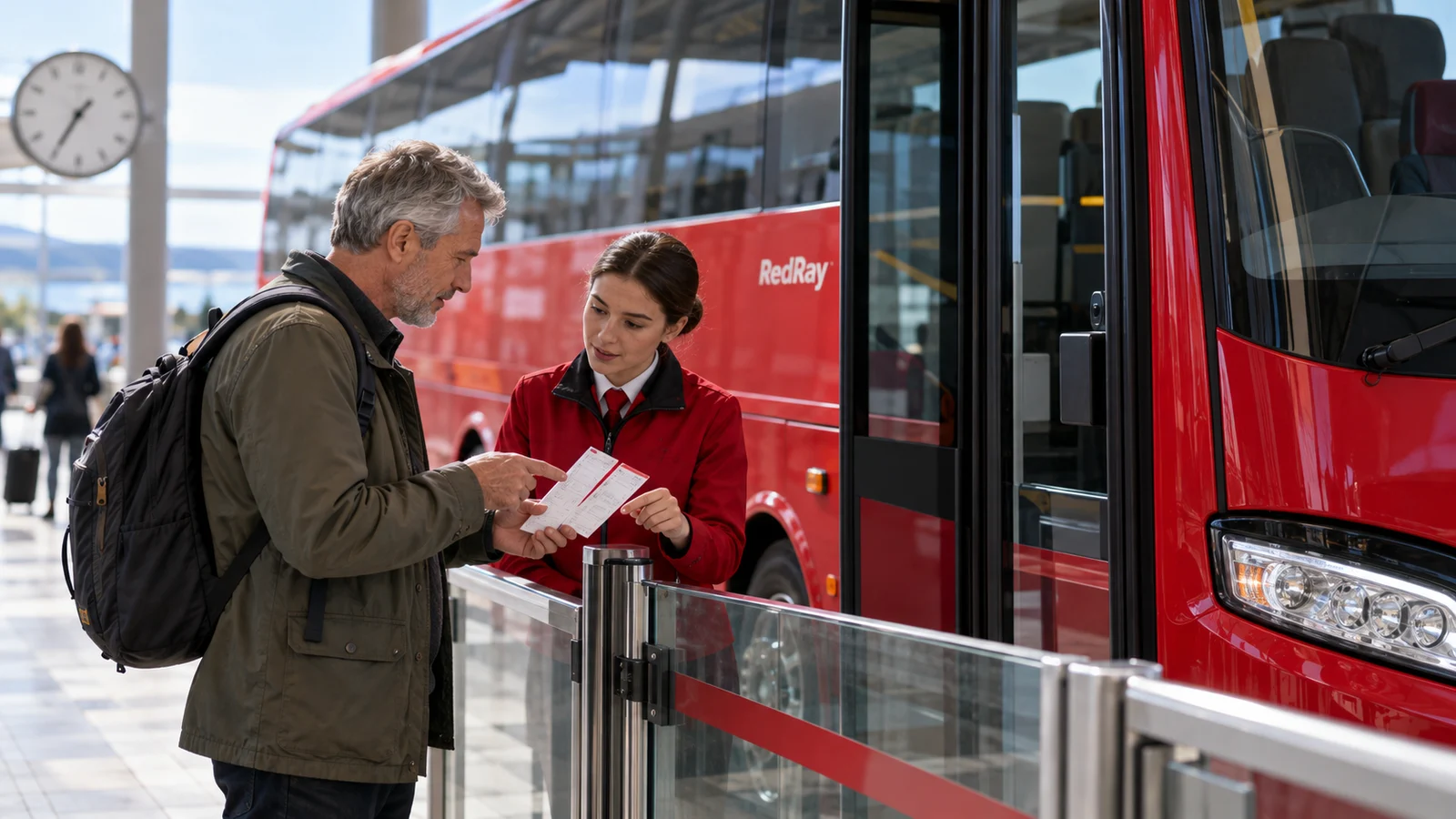
Separate three easily confused moments
The first is when you must be ready for checking at a designated place. The second is when staff finish accepting passengers or a separate check-in procedure. The third is the bus’s scheduled departure. A particular company may describe these moments differently; do not assume they are identical from one ticket field.
Find not only the prominent departure time in your confirmation but also the arrival instruction. Check email attachments, conditions of carriage and special directions for your point. Distinguish a recommendation to arrive early from a condition linked by the operator to retaining your seat: if the wording is unclear, ask the seller or carrier to explain it before travelling.
National Express’s official conditions separately describe appearing early at the boarding point and the consequences of lateness. FlixBus conditions also contain provisions on starting the journey and passengers being present on time. These are examples from particular networks, not one deadline for international buses. Check your service operator’s document, including any special conditions.
Plan the journey to the check, not the station building
Getting out of a taxi outside the terminal and being ready to board are different events. Finding the entrance, reaching the right level, checking the platform, queueing and preparing luggage may still lie between them. Plan to arrive where passengers are actually accepted, not merely at the complex’s address. Do not shorten the way through service passages or bus traffic lanes.
Open your ticket and appropriate document before your turn. If several passengers’ tickets are on one phone, give files clear names and send adults their own copies. The suitcase should be ready for agreed handover, while necessary documents stay with you. Searching for a passport in the luggage compartment is not a reliable last-minute strategy.
A delayed city bus, a café queue or a lengthy goodbye does not automatically change the international boarding deadline. If you see you will not make it, contact the official contact and state your actual location. A message may help obtain current instructions, but does not guarantee the vehicle will wait or your seat will be retained.
What to do at closed doors
- Remain in the permitted passenger area, do not stand in front of the bus and do not touch its mechanisms.
- Contact boarding staff or a crew representative able to check this particular service. Show your ticket, date and departure point.
- Clarify the reason: acceptance has ended, another platform, the wrong service, no booking or a separate document problem.
- Ask whether admission is possible under the current procedure. If not, ask who can check an available change or next travel option.
A brief request is more specific than an argument: “My ticket is for this service from this point. I am at the platform now. Please explain which procedure has ended and what I can do officially.” Do not demand that the driver answer during a manoeuvre. If they are already busy departing, contact available staff or support from a safe place.
Do not hand your phone to someone promising to “reopen boarding” for a private surcharge. Checks go through the responsible party, not a random intermediary. Do not share bank codes or transfer money to a personal card for a promise to influence the driver. Every new payment needs a clear purpose and proper confirmation.
Passenger lateness and early bus departure are not the same
If you arrived after the specified deadline, record that fact accurately rather than substituting the time you entered the premises. If you were ready at the correct place early but were not checked, the circumstances of refusal need separate clarification. Do not reach a final conclusion simply because the bus remains visible through a window: door status and actual departure are different facts.
Record your arrival time at the platform, contact time and the staff member’s explanation. Keep your own ticket, current service notification and support response. “Where I was—when I asked—what they answered” is useful, unlike a collection of random photos. Do not gather other people’s passports, passenger lists or videos of faces in the queue to strengthen evidence.
If departure was delayed, clarify which updated arrival and boarding arrangements were communicated to you. A bus icon on a map or a phrase in a passenger chat does not replace those instructions. Do not leave the platform solely because someone mentioned a long wait: a changed forecast does not always permit arriving later without checking.
Check the old order before another purchase
Ask for the unused ticket’s status and actions available under its conditions to be explained. A change, a new purchase and an enquiry about the previous payment are separate procedures. Do not fully cancel a family order if the problem concerns one person or section. Clarify consequences for the remaining journey before confirming a change.
If you decide to buy another service, check its actual departure point, date, boarding-readiness requirement and luggage conditions. Another departure from the same city may use a different terminal. First assess whether you can realistically reach it without unsafe rushing. A new payment does not itself mean the previous purchase will be refunded, even if both tickets came through the same service.
Separately update meeting arrangements and onward connections. Report confirmed changes, not a hoped-for arrival time. If there is no definite solution yet, say directly that an option is being checked. This reduces the risk of relatives or a subsequent carrier planning around a service you were not admitted to.
Questions and answers
Must they accept me if there is still time before departure?
The fact that departure time has not arrived does not answer that question. Check boarding-readiness conditions, your actual arrival place and time, and the refusal reason. Ask responsible staff to check the specific ticket; do not try to force admission.
I was already queueing but had not reached the check. What should I say?
Report when and which queue you joined, show the service and ask how staff register passengers waiting for checks. Do not run to another entrance without instructions. For a later enquiry, record facts rather than merely “I was at the station”.
Can I board at the next stop after boarding closes?
Do not plan this independently. The ticket is issued from a particular point, and joining later may be unavailable. First obtain carrier confirmation and proper processing of a change, if allowed at all. Do not pursue the bus by an unsafe route.
Will calling the driver to ask them to wait help?
It creates no guarantee of waiting. Use the official operational contact, state your real location and do not distract the driver while moving. You need an answer about the permitted next step, not a promise from an unknown person.
How should I prepare to avoid a repeat?
Save the departure time separately from instructions on readiness for checking, verify the route to the platform and prepare documents. Allow time for actual access with luggage. Before the return journey, reread its operator’s conditions rather than automatically applying the first service’s rule.
Useful links and sources
For a general plan, read how to avoid missing an international bus. Examples of boarding-readiness conditions appear in National Express conditions and FlixBus conditions of carriage. They do not replace your carrier’s rules. Sources checked on 23 October 2026.