

The bus reaches the port and waits with other vehicles to board the ship. You hold a bus ticket to a city abroad, not a separate plan to explore the port. Now it matters whether the journey will continue in the same vehicle after the crossing, when you must leave the passenger compartment and how to find your service again. The usual idea of “I will walk away at the stop and return whenever I want” may not work here.
This article concerns transport of the bus itself. If you get off in port and separately board the ship as a foot passenger, the procedure differs. For a particular crossing, instructions from responsible port staff, the ship’s crew and your carrier govern. This article does not establish universal deck access, boarding methods or ferry equipment.
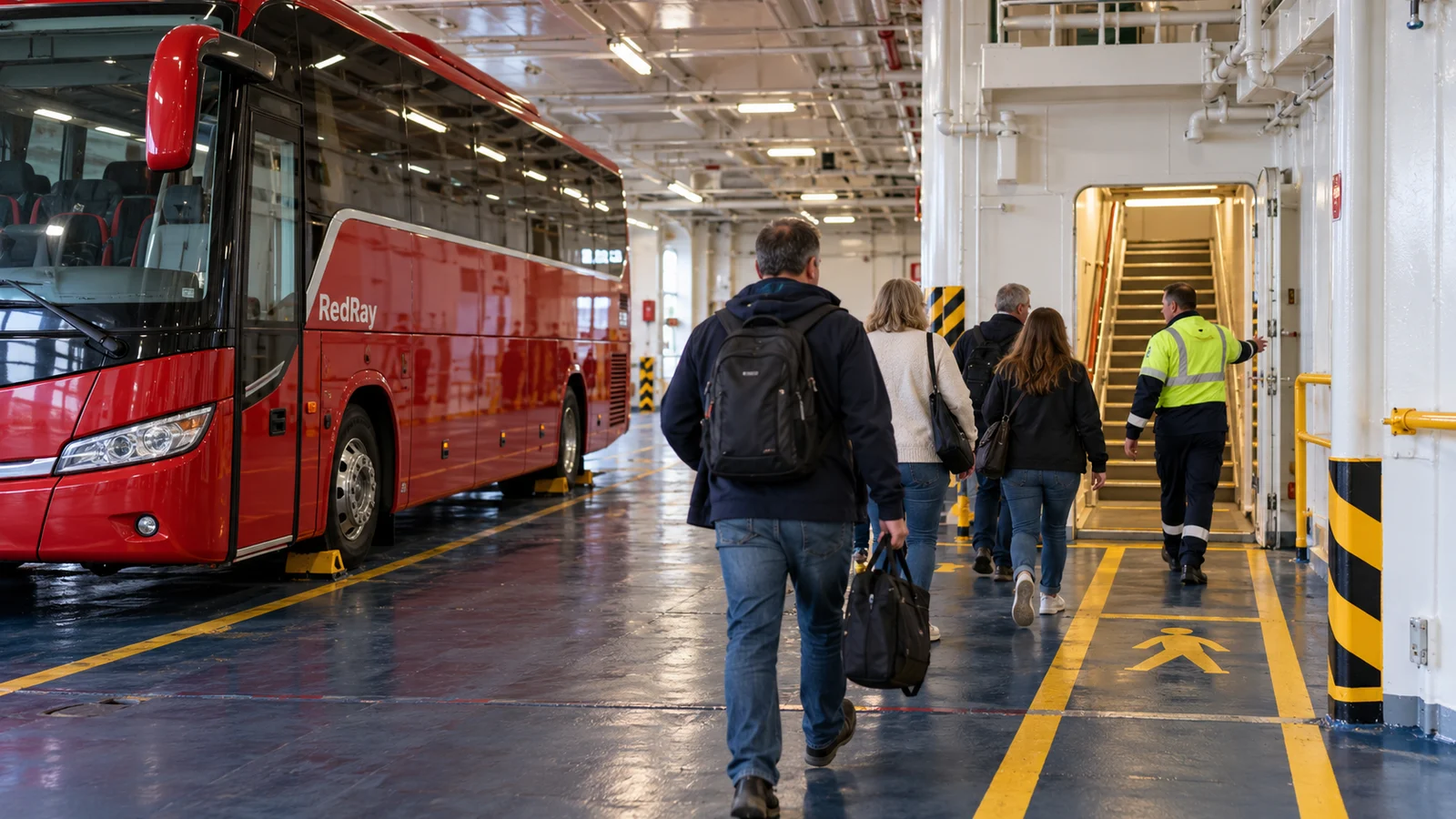
Confirm what the ferry stage includes
Before travelling, ask the carrier whether the same bus remains after the sea section, how passengers’ carriage on it is arranged and whether there is a separate checking procedure. The final city’s name does not explain every intermediate action. Do not independently buy an extra place on the ship simply because you saw a port on the route: first establish what your booking already includes.
Ask for a brief description of the sequence: where to receive instructions, whether passengers get off before or after the bus boards, how to recognise the crew and where to assemble for continuation. The actual procedure depends on the port and service. Do not reconstruct it from a video of another crossing, even if it features the same company’s bus.
If you only learn about the ship during the journey, clarify the arrangements at a safe stop without distracting the driver from manoeuvring. It is especially important to report mobility difficulties, accompaniment needs or essential items in a suitcase immediately. A port queue is a poor moment to first announce that a passenger cannot use the proposed route.
Assemble a small set before leaving the bus
Keep the appropriate documents, phone, ticket, necessary medication and items you cannot do without during the crossing with you. Clarify what is permitted and necessary in the passenger area. Do not plan to return to the luggage compartment midway through the sea section: access to the vehicle deck may be restricted.
Prepare the set before the relevant manoeuvres begin, not amid people on the stairs. Take only what you can safely carry by the permitted route, leaving yourself able to use a handrail if needed. Do not burden yourself with every piece of luggage without crew instructions. Arrangements for a large suitcase and unusual items need separate clarification.
Prepare a child’s essentials for this section without assuming the bus will be accessible at any moment. Adults should know who carries shared belongings, and everyone should have access to their own documents. A shared bag left in the passenger compartment with another family member creates unnecessary dependency if you are temporarily directed along different routes.
Remember the route, not only the bus colour
Once the vehicle has completely stopped, get off when and where responsible staff direct you. The vehicle deck may have different levels, rows and exits to passenger areas. Note the location markings and permitted passage. Do not remain between vehicles to choose a better photo or wait for friends in a manoeuvring area.
Remember your bus’s number or other identifier, the permitted exit’s location and how to contact the crew. If photography is allowed and does not delay movement, you can save only the required landmark without other people’s documents. But do not rely solely on a photo: if unsure, a ship staff member confirms the route, not a random passenger.
Do not open service doors or seek a shortcut through barriers. The passage you used going up may be unavailable at a particular moment, and similar doors may lead elsewhere. It is better to tell a staff member the deck or bus identifier and ask for directions than test every exit yourself.
Do not expect unrestricted vehicle access during the crossing
For example, Stena Line’s official guide explains that passengers do not remain in their vehicles at sea, the vehicle deck is closed and return is announced after arrival. This is the named operator’s rule; confirm your ship’s actual conditions separately. Do not use someone else’s exception as permission to return to the bus independently.
If an essential item remains on board the bus, contact responsible ship staff and explain exactly what you need. If possible, inform the bus crew at the same time. Do not bypass closed access or ask another passenger to “take you through unnoticed”. Staff will determine whether there is a permitted solution; a ticket does not grant independent access to a restricted area.
Find out how return will be announced and remain attentive to announcements. Do not choose a waiting place solely for comfort if the necessary information cannot be heard or seen there. If hearing or understanding the language is difficult, ask in advance for an accessible way to receive the message to be explained, without assuming automatic personal assistance.
Returning to the bus: a separate check before continuation
Do not start going down simply because land is close or others are gathering belongings. Wait for the permitted return procedure. Take your set and check the waiting place for a phone, documents or a child’s item left behind. Do not create a queue at closed doors hoping to be first.
On the vehicle deck, follow the permitted route and check the bus before entering. A similar vehicle may be nearby, and the crowd may be heading to other transport. If you cannot see your service, ask a staff member, giving the company and known identifying features. Do not independently leave onto the quay or cross vehicle traffic to search from the other side of the ship.
On the bus, check that companions have returned and essential belongings are with you. If someone is absent, tell the crew specifically whom you are waiting for, where you last saw them and whether contact is available. Do not get off again to search without agreement. The bus crew and ship staff need to coordinate permitted actions, not guess where another passenger disappeared.
Plan assistance for the entire movement between areas
“I need help on the ferry” is too general. Explain which actions you cannot do independently: travel from the bus door, use stairs, carry a small bag or return to the required level. Clarify who is responsible for assistance on each part. The bus carrier’s confirmation does not automatically describe a particular ship’s capabilities.
Do not expect a lift, chair, cabin or another facility solely because it existed on a previous crossing. Ask for the necessary provision to be checked for the planned service and for an alternative if arrangements change. If a new vehicle or ship is used, remind staff of the agreed need before disembarking rather than accepting unexplained improvisation.
After the crossing, estimated bus arrival may be updated. Tell people meeting you about the confirmed next stage, not merely the ship’s appearance near port. Vehicle disembarkation, permitted departure and the journey to your bus stop are separate actions. Do not promise an exact time merely because the sea section seems finished.
Questions and answers
Can I stay asleep on the bus during the crossing?
Do not decide this independently. Follow the particular ship’s rules and staff instructions. In particular, the Stena Line guide cited does not permit passengers to remain in vehicles at sea. Convenience or tiredness does not replace permission.
I forgot necessary medication on the bus. Should I fetch it?
Tell ship staff exactly what happened and ask for a permitted solution. Do not open restricted passages or go down without authorisation. If urgent help is needed, say so immediately rather than disguising it as a general request to collect a bag.
Do I need to get off in port as a foot passenger?
That depends on the confirmed transport arrangement. On a through-bus service, do not separate from it without instructions. Ask exactly where disembarkation and reboarding happen, and do not randomly use another passenger category’s procedure.
What if I cannot find the bus after the announcement?
Ask a staff member in a permitted area and provide the known vehicle and service details. Contact the bus crew if possible. Do not go onto the quay or cross moving traffic to search.
Can I treat the sea section as an ordinary long stop?
No: vehicle access and return arrangements may differ. Prepare essential belongings before leaving, then follow ship instructions. An agreed bus contact is useful, but does not replace staff permission to move between decks.
Sources and related situations
Another scenario is described in the article on a separate transfer from a bus to a ferry. For access rules, check the Stena Line guide; for vehicle carriage information, see the official DFDS page. Sources checked on 23 October 2026.