

You see a red bus opposite and receive “we are on the other side”. Several traffic lanes, a barrier or a complicated junction separate you, and your suitcase makes moving quickly difficult. The worst decision is to treat visible proximity as permission to run straight across. First confirm the boarding point and find a permitted safe pedestrian route.
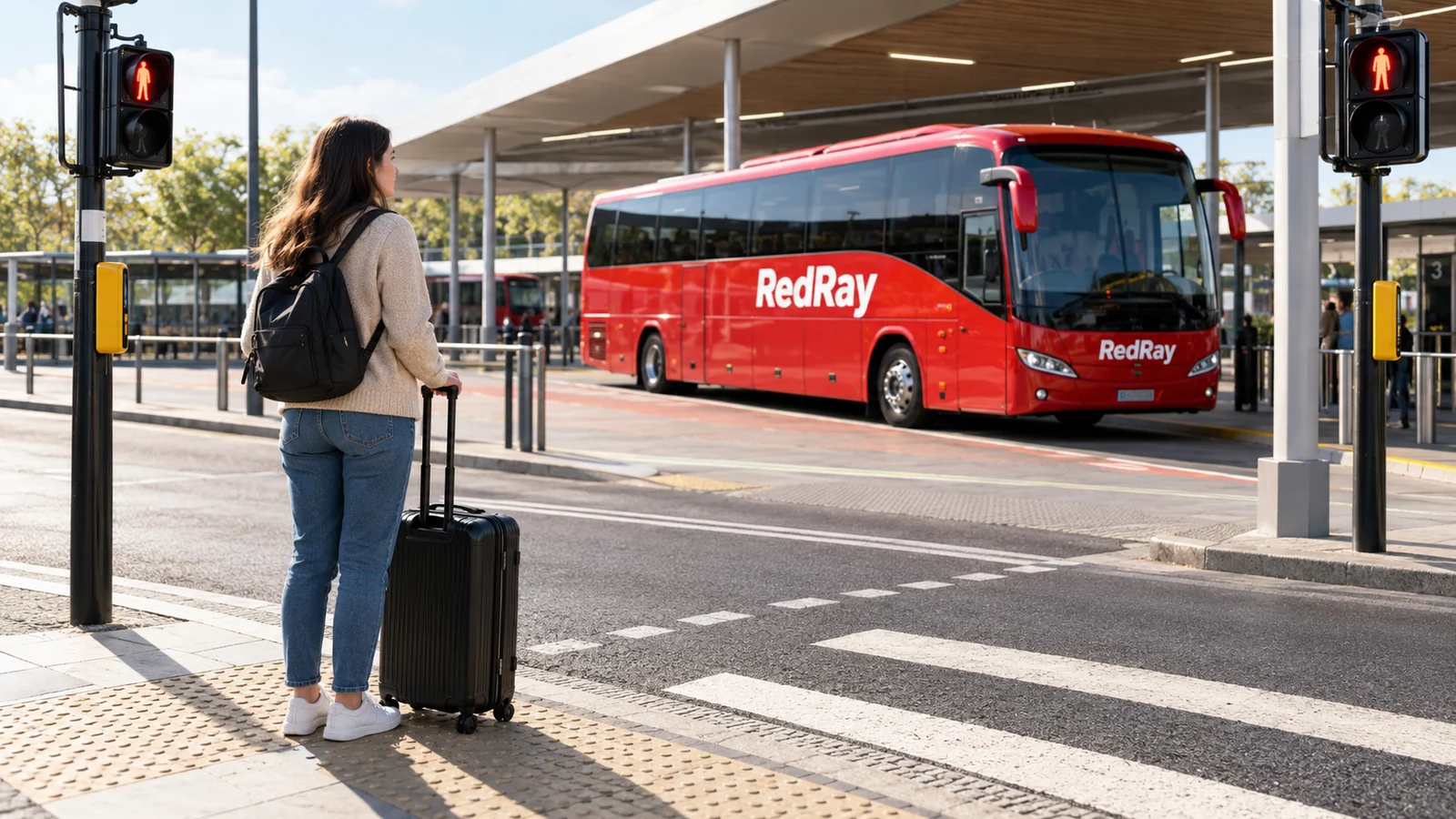
The gap between a map pin and actual access is particularly noticeable near large complexes, bypasses and multilevel terminals. A short straight-line distance may say nothing about pedestrian access. These instructions help organise address checks and contact with the service, not ways around road restrictions.
Stop somewhere safe and check the address
Do not read messages at the edge of the road or between parked vehicles. Move to a permitted pedestrian area and open your ticket and latest boarding confirmation. Check the stop name, street side and landmark if provided. The bus opposite may be another service or not at a passenger boarding point.
If an address change arrived recently, verify its source through a known contact. Do not cross merely because a stranger waves. Ask for the particular service, date and agreed boarding point to be confirmed. If details conflict, tell the carrier rather than choosing whichever bus is more visible.
Do not rely only on the direction of street traffic. Boarding may be on separate premises with its own entrance, and the opposite vehicle may reach it by another route. You need pedestrian directions specifically. Driving navigation can lead through an access road not intended for someone walking with a suitcase.
Ask the carrier a specific question
Say where you are and what blocks access: “I am at this entrance on this side of the street. There is a barrier between me and the bus, and I cannot see direct pedestrian access. Please explain the official approach.” A visible landmark or exact address is better than “I am nearby” when you are on different road levels.
Ask about the permitted crossing, required entrance and boarding side. Do not simply ask staff to “stop traffic by waving” if that is not the proper procedure there. A driver’s or passenger’s gesture does not replace traffic signals and road rules. You need to understand a safe route, not merely be encouraged to hurry.
If the answer is “run across, everyone does”, do not treat it as justification for danger. Explain that direct access is unsuitable and ask for an available lawful alternative. Do not promise an arrival time you cannot meet safely. Honestly explain that a detour is required and you have not reached boarding.
Find a permitted pedestrian route, not the shortest line
Use walking mode on a map and compare it with actual signs, signals and barriers. The map may miss temporary closures or new roadworks. If it proposes going through a barrier, service yard or closed entrance, do not follow mechanically. Clarify locally or with the responsible party.
Use the designated crossing and follow local rules and signals. Do not step suddenly into the road for a bus or assume drivers will see you. Ukraine’s Patrol Police specifically warns pedestrians about sudden entry onto the carriageway. Abroad, check that country’s rules rather than automatically applying familiar arrangements to an unfamiliar location.
Do not climb central barriers or use gaps between vehicles as an improvised passage. Even when the bus is very close, running with luggage reduces awareness and control. A calm permitted route matters more than saving a few minutes; approaching departure does not make the risk acceptable.
Allow for luggage, children and crossing accessibility
The route may include stairs, a long underpass or a separate platform entrance. If luggage or a particular need prevents you using it, say so before attempting to cross. Do not treat strangers carrying a person or belongings through a dangerous area as a universal solution.
For a family, agree in advance who watches the child and hand luggage. Do not split the group so the child stays on one side while every adult rushes to the bus. If some have crossed, do not signal others to run directly over. Communicate from a safe place and repeat the agreed route.
Do not pass a suitcase over a road barrier while staying on the other side. It may reach someone whose identity and authority you have not checked while you still lack boarding access. Hand over luggage in the proper place after confirming the service and following crew procedures.
If the detour takes longer than the time remaining
Tell the official contact immediately where you are, which permitted route you found and roughly how long it will take. Do not turn a map estimate into a promise: crossings may involve waiting or other obstacles. Ask what actions are available for boarding without assuming the bus will definitely wait indefinitely.
Do not demand an illegal stop on your side of the road. Movement and boarding arrangements must suit the location and rules. If the carrier can offer another proper option, establish the precise address and procedure before moving. Walking along the road towards the next bend hoping to catch up is unreliable and potentially dangerous.
If you miss boarding, first arrange a safe waiting place and communication. Then establish ticket status and available alternatives through the seller and carrier. Do not assume a free replacement service or reimbursement of every expense. Keep address facts and instructions received for a later review of the particular situation.
What to record if the location was ambiguous
Keep the ticket, map or message giving the address and the carrier’s clarification. Record when you reached the stated location and subsequent events. Where permitted and safe, you can photograph a general landmark, but not while crossing or standing in a traffic area. Safety matters more than an evidence photo.
Separate facts from your assessment in a complaint. “The message did not state the street side; there was a barrier beside the pin; I asked for clarification at this time” is understandable. “Everyone deliberately makes passengers take risks” is a broad allegation your material may not support. Precision helps establish where the mistake occurred.
Before your next journey, review pedestrian access rather than merely placing a roadside pin. Save the correct entrance and a permitted backup route. Clarify an unclear address before payment or before leaving home. This reduces dependence on hurried calls at the location, but does not replace checking current service messages.
Questions and answers
If the driver gestures to cross directly, can I?
Do not treat a gesture as a substitute for road rules and a safe crossing. Ask for permitted pedestrian access and explain if the direct route is unsuitable.
Can I trust a walking map that goes through a closed passage?
Compare navigation with actual signs, barriers and temporary restrictions. Do not enter closed or staff-only premises merely because of a route line on screen.
What should I tell the carrier if the permitted detour takes too long?
Give your exact location, obstacle and approximate safe approach time. Ask about available actions without promising an unsafe shortcut or assuming guaranteed waiting.
What should I keep for a complaint after missing boarding?
The address document, change or clarification messages, arrival time and content of official-channel conversations. Do not take road risks for extra photographs.
Official source and useful links
Basic pedestrian reminders are available from Ukraine’s Patrol Police. Source reviewed on 21 October 2026; another country’s local rules apply there. Check contacts for your purchase on the RedRay website, and other advice in the RedRay blog.